Executive summary
Structured-product selection is two decisions, not one: the payoff shape the client wants, and the wrapper it is held in. The two are routinely collapsed into a single product recommendation. This report separates them, maps what the listed market actually offers by shape, and sets out the seven-step process applied to any replication request.
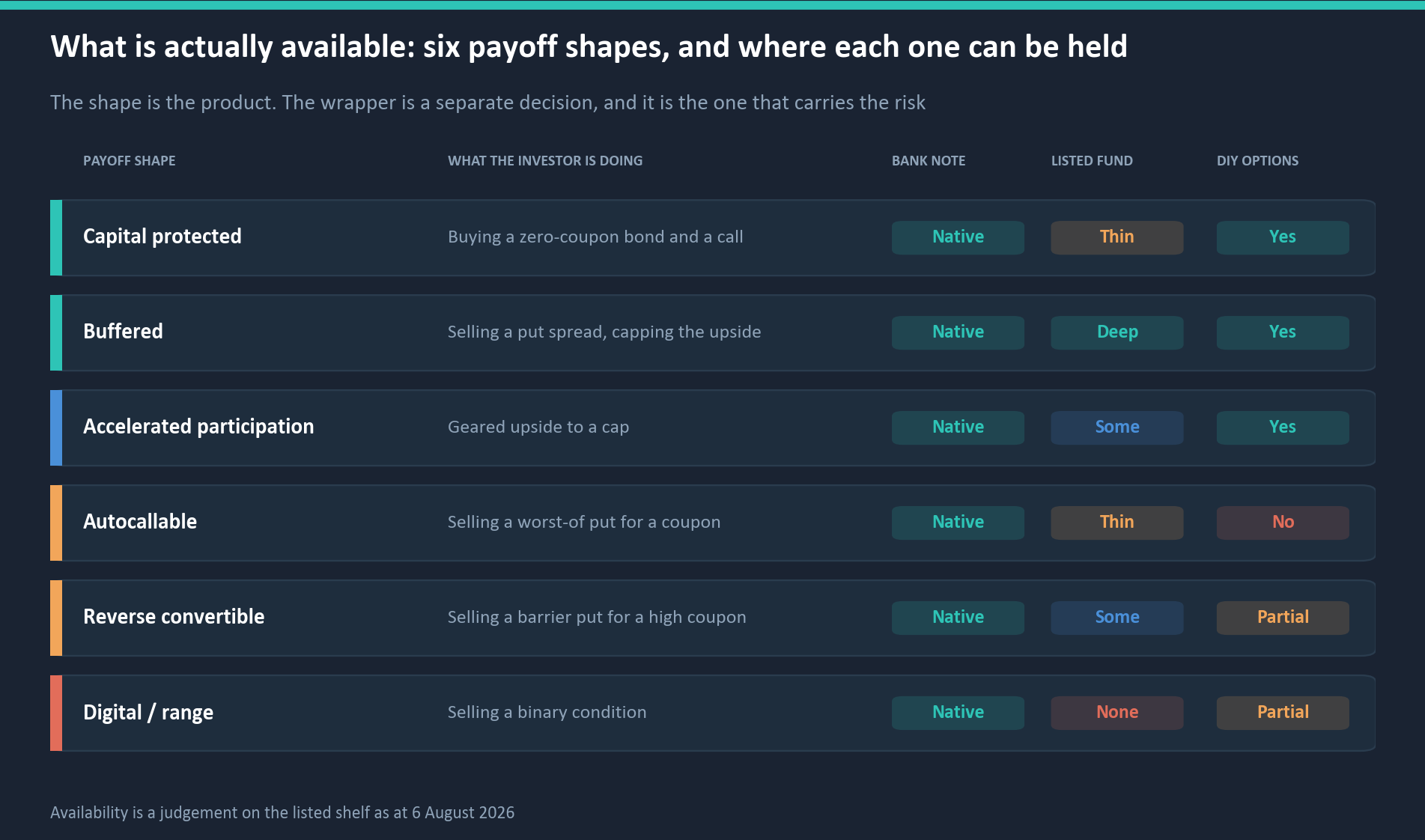
- 1Six payoff shapes account for effectively the whole market. Capital protected, buffered, accelerated participation, autocallable, reverse convertible, and digital or range. Naming the shape converts an apparently bespoke product into a comparable one.JUDGEMENT
- 2In four of the six, the investor is the seller of optionality. The coupon is premium received for a risk assumed, not yield. In autocallable and reverse convertible structures that risk concentrates precisely where diversification fails, because a worst-of payoff settles on the single worst performer rather than the average.JUDGEMENT
- 3The wrapper decision carries the risk and is systematically under-examined. The same payoff diagram can rest on issuer credit alone, on segregated fund custody, or on exchange clearing. Cost is embedded and unquoted in the first case and disclosed at 0.25% to 1.33% in the second.VERIFIED
- 4The listed shelf is deep in two shapes and thin in three. Of $290.0bn across 347 US funds, covered-call income and standard buffered exposure account for $218.4bn. Capital protected floors total $3.2bn across 4 funds, autocallable and contingent coupon $4.1bn across 12, accelerated participation $2.7bn across 37.VERIFIED
- 5Most index-linked requests should terminate at step two. Where a listed fund already matches the target buffer, cap and tenor, the client obtains daily liquidity, disclosed holdings, a quoted fee and no issuer-credit exposure, and the remaining steps are unnecessary.JUDGEMENT
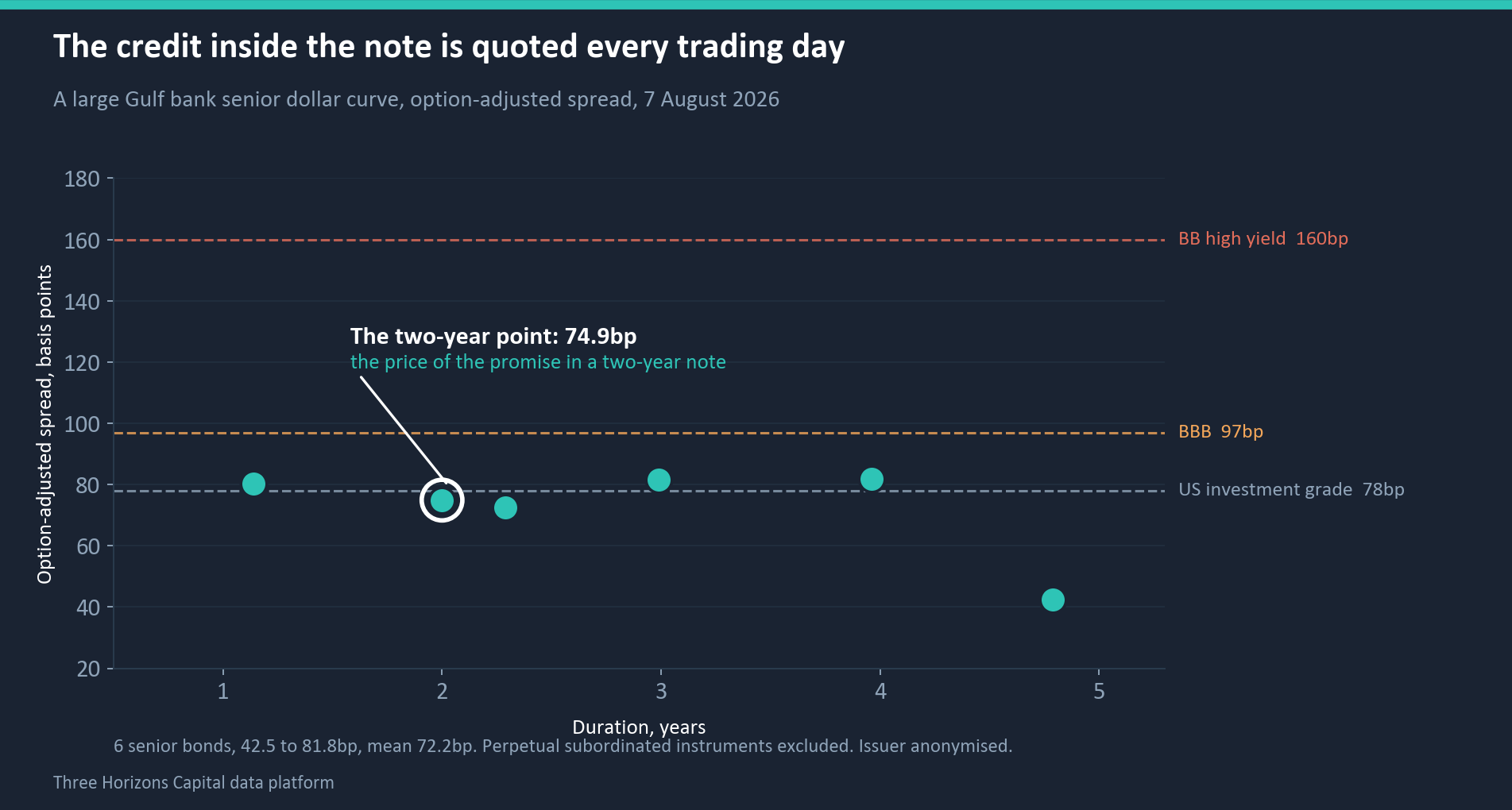
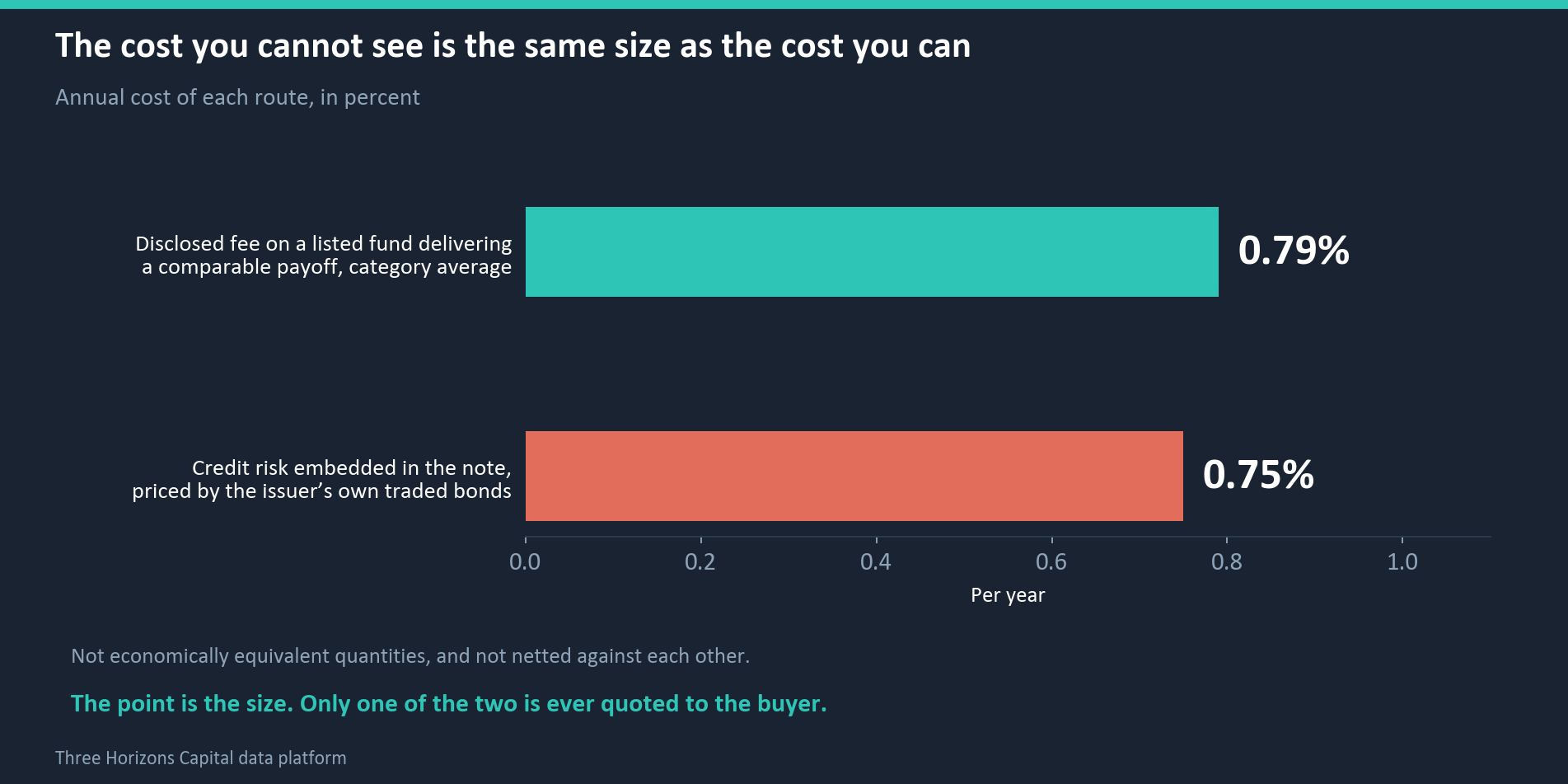
- 6Where the answer is a note, issuer credit is observable and is not being priced by buyers. For a representative Gulf bank issuer, six senior dollar bonds traded at 42.5 to 81.8 basis points on 7 August 2026, two-year point 74.9, inside the investment-grade index at 78 and in line with a peer median of 79.5 to 82.1. Approximately 0.75% per annum of credit compensation, against an average disclosed fee of 0.79% on the listed route.VERIFIED
The operating recommendation
Decide the shape, then the wrapper, then the product, and keep the three as separate auditable steps. Screen the listed shelf before accepting that a bespoke build is required. Where a note is genuinely indicated, price the issuer’s credit from its own traded curve before sizing, because the portfolio model does not represent default risk and the term sheet does not itemise it.
Six payoff shapes account for effectively the whole market
| Shape | Economic position taken by the investor | Mandate it serves |
|---|---|---|
| Capital protected | Long a zero-coupon bond, discount spent on a call | Upside required, principal cannot be impaired |
| Buffered | Short a put spread, upside capped to fund it | Will absorb a normal correction, not a crash |
| Accelerated participation | Geared upside to a cap | Moderately constructive, wants more than index |
| Autocallable | Short a worst-of put on a basket | Expects no large drawdown, wants paid for the view |
| Reverse convertible | Short a barrier put | Income, and willing to own the underlying |
| Digital or range | Short a binary condition | Precise view on a boundary |
Four of the six make the investor short optionality
The coupon in a buffered, autocallable, reverse convertible or digital structure is premium received for risk assumed, not yield earned. In the worst-of structures the exposure is to correlation breakdown, which is to say it concentrates exactly when diversification is most needed. This is a characteristic of the shape, not a defect in any particular product, and it should be established before terms are negotiated.
The wrapper determines the risk, and is a separate decision from the shape
| Attribute | Bank note | Listed fund | Direct options |
|---|---|---|---|
| Legal form | Senior unsecured debt of the issuer | Regulated fund holding listed options | Contracts held by the client |
| Principal secured by | Issuer credit alone | Segregated fund custody | Exchange clearing, US sovereign |
| Liquidity | Issuer bid only | Daily, exchange-traded | Daily on broad indices |
| Cost | Embedded, not itemised | Disclosed, 0.25% to 1.33% | No wrapper fee; spreads and margin |
| Customisation | Unconstrained | Standard shapes only | Single index, standard tenors |
| Client operational burden | None | None | Material and ongoing |
The wrapper decision determines credit exposure, liquidity, tax character and the visibility of cost, while leaving the payoff diagram unchanged. It is nonetheless the less documented of the two decisions at the point of sale: a note’s offering material typically devotes several pages to the participation mechanics and a single sentence to the issuer.
The listed shelf is concentrated in two shapes and thin in three
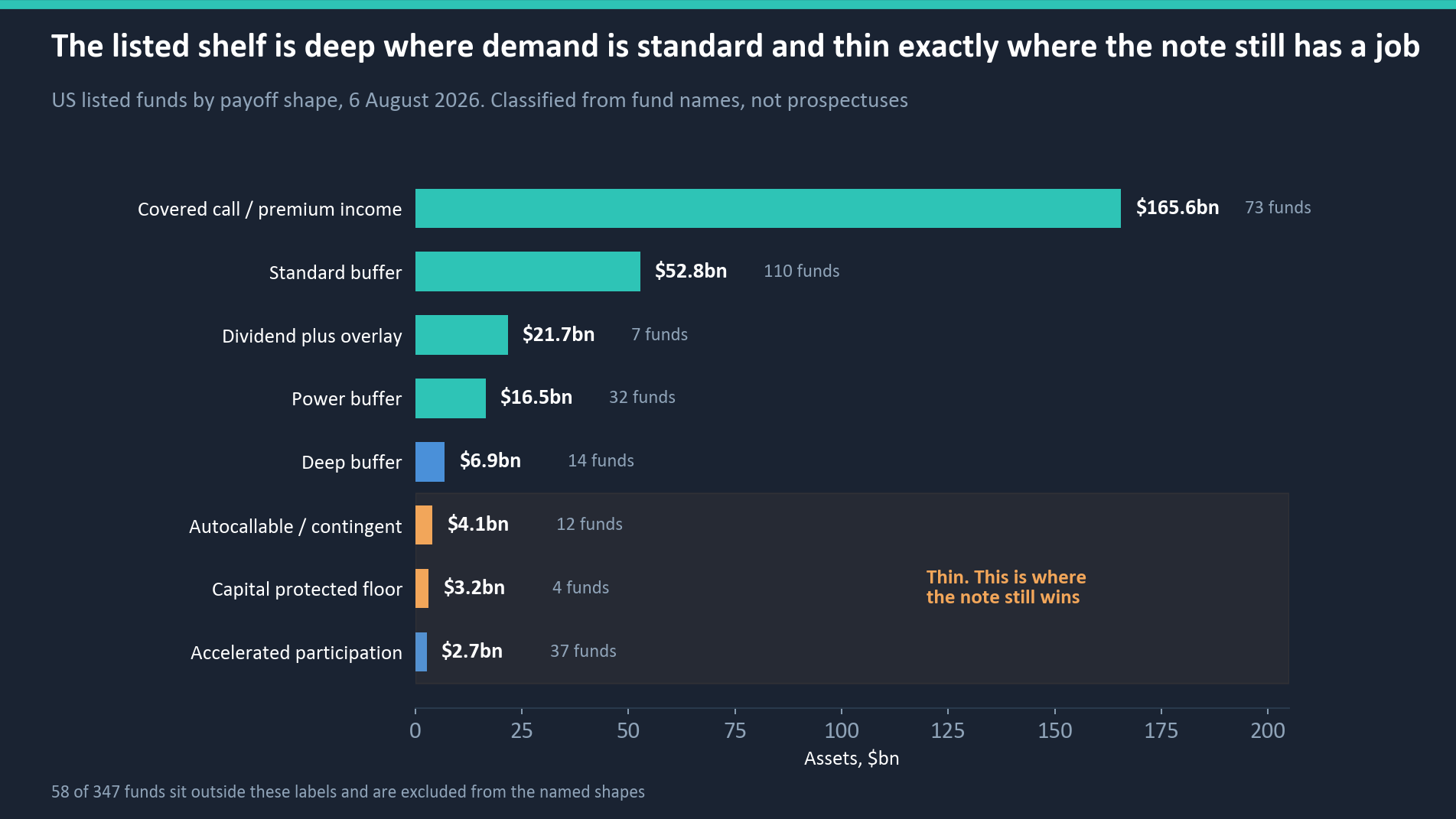
| Payoff shape | Funds | Assets | Read |
|---|---|---|---|
| Covered call and premium income | 73 | $165.6bn | Deep, liquid, competitive |
| Standard buffer, approx. 9 to 10% absorbed | 110 | $52.8bn | Deep |
| Dividend plus overlay | 7 | $21.7bn | Concentrated |
| Power buffer, approx. 15% absorbed | 32 | $16.5bn | Adequate |
| Deep buffer, approx. 25 to 30% absorbed | 14 | $6.9bn | Adequate |
| Autocallable and contingent coupon | 12 | $4.1bn | Thin; standardised baskets only |
| Capital protected floor | 4 | $3.2bn | Effectively absent |
| Accelerated participation | 37 | $2.7bn | Exists on paper, thin in practice |
Total 347 funds, $290.0bn. Classification is derived from fund names rather than prospectus review; 58 of the 347 fall outside these labels. The shape split is therefore indicative and the totals exact.
What the distribution tells a selector before any analysis
The listed market has industrialised the standard shapes and barely addressed the bespoke ones. A request for buffered or income exposure on a major index is a shopping exercise in a competitive market. A request for a hard capital floor, a bespoke autocallable, or geared participation is a different conversation, and the shelf will frequently be unable to help.
The seven-step process applied to any replication request
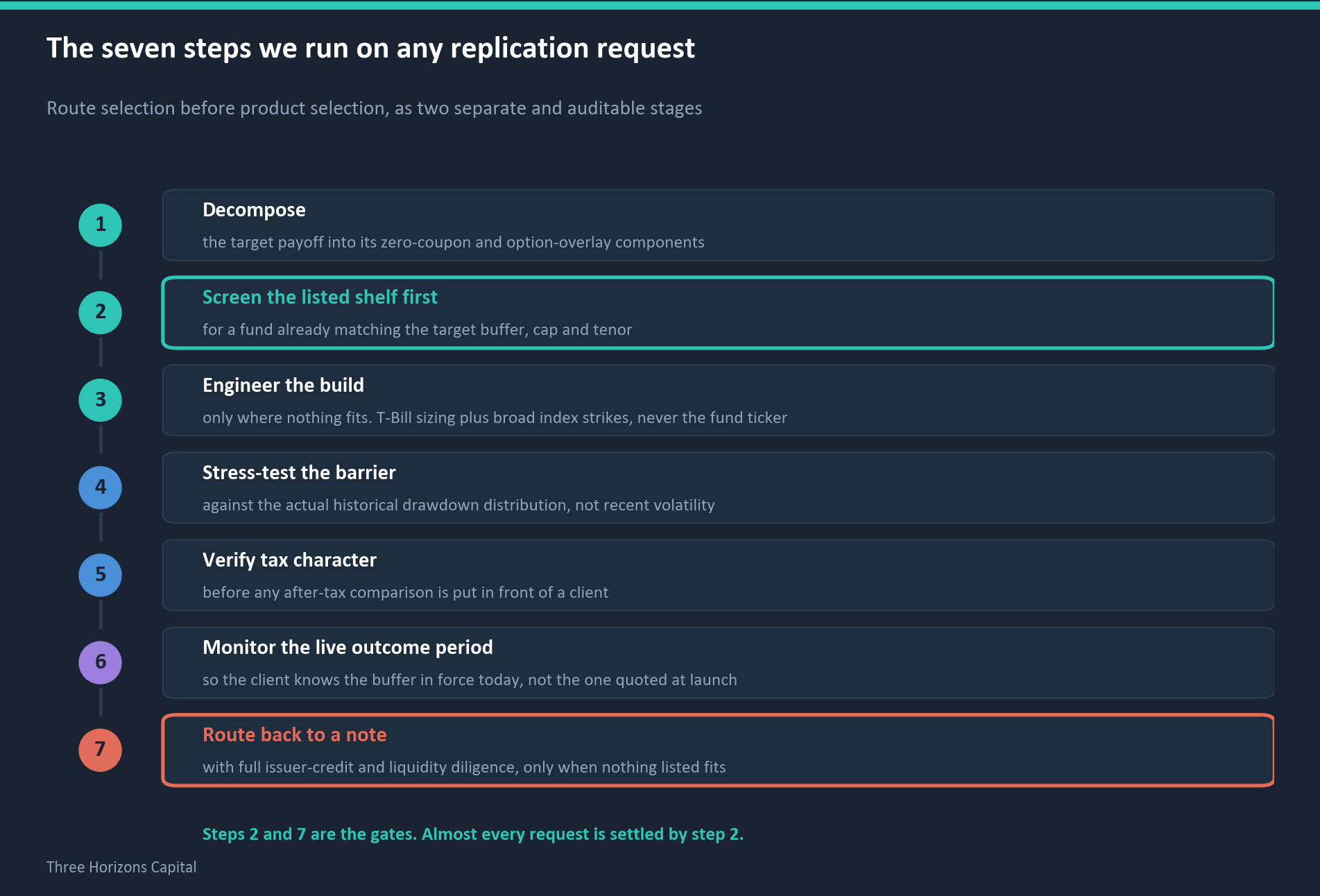
- 1Decompose the target payoff into zero-coupon and option-overlay components. Every shape reduces to a bond plus an option position; until that is written down, nothing downstream is comparable.
- 2Screen the listed shelf first for a fund matching the target buffer, cap and tenor, including listed autocallable-income funds for standardised basket payoffs. A gate, not a formality.
- 3Engineer the build only where nothing fits T-Bill sizing plus index option strikes. For S&P 500 exposure, SPX or XSP and never SPY, since only the broad-based index contract carries the treatment; NDX rather than QQQ, RUT rather than IWM.
- 4Stress-test the barrier against the underlying's realised historical drawdown distribution rather than trailing volatility.
- 5Verify tax character before any after-tax comparison is presented. Notes are frequently ordinary income at maturity and may create imputed income annually with no cash distributed; funds pass through the character of their own option book, which the holder does not control.
- 6Monitor the live outcome period and roll dates so the buffer and cap in force are known, rather than those quoted at fund launch. Mid-cycle purchases receive the residual.
- 7Route back to a note with full issuer-credit and secondary-liquidity diligence, only where a fully bespoke basket, a worst-of on custom underliers, or a tenor beyond approximately three years has no liquid listed alternative.
Steps two and seven are the gates
Everything between them is engineering. On the evidence of section 04, the large majority of index-linked requests terminate at step two, which is both the least expensive and the fastest outcome available to the client. The steps most frequently omitted in practice are six and seven: the first because it is continuous and unglamorous, the second because pricing issuer credit is assumed to be difficult.
Step seven: issuer credit is observable, and is not being priced by buyers
Where a note is indicated, the client assumes the issuer’s unsecured credit for the life of the structure. The offering material addresses this with a rating. The market prices it continuously: if the issuer has public debt outstanding, the risk being transferred is quoted in basis points every trading day. The following is a representative worked example on a large Gulf commercial bank of the type distributing these structures regionally. The issuer is anonymised.
| Measure | Value | Basis |
|---|---|---|
| Securities held for the issuer | 12 | 10 senior with a live spread print, 2 perpetual subordinated |
| Senior dollar bonds, duration 0.5 to 5.0 years | 6 | Maturity range relevant to a two to five year structure |
| Option-adjusted spread, range and mean | 42.5 to 81.8bp, mean 72.2 | 7 August 2026, latest print per security |
| Two-year point | 74.9bp | Duration 2.00 bond |
| Peer median, same basis | 79.5 to 82.1bp | Three comparable regional banks; issuer median 80.3bp |
| Market context | 78 / 97 / 160bp | US investment grade, BBB, BB high yield, same date |
A positive credit finding, and that is the point
The issuer’s two-year paper trades inside the investment-grade index average and in line with its peer cohort. The finding is not that the credit is weak. It is that the credit has an observable, unremarkable price which the purchaser of a note is never shown. Expressed for a client: a two-year note from this issuer carries credit risk the market prices at approximately 75 basis points per annum, or about 1.5% of principal over the life of the structure. An approximation which ignores recovery assumptions; the spread compensates for liquidity as well as default risk.
Set against an average disclosed fee of 0.79% on the listed route, the two are of comparable magnitude. They are quantities of different kinds and are not netted here. The commercial case for a note rests implicitly on the absence of a visible expense ratio; the cost is not absent, it is unquoted.
Route selection by client situation
| Client situation | Default route | Rationale |
|---|---|---|
| Standard buffer or income payoff on a major index, off-the-shelf terms acceptable | Listed fund | No issuer-credit exposure, daily liquidity, disclosed holdings, sub-1% fee. Settles most requests |
| Single broad index, tax character is the priority, client can carry operational load | Direct index options | Best available character, conditional on the index contract rather than the fund ticker |
| Fully bespoke basket, worst-of on custom underliers, or tenor beyond approx. three years | Note | Correlation is not a traded input; no listed substitute exists |
| Capital protection with a hard floor | Usually the note | Only 4 listed funds and $3.2bn exist in this shape |
| Concentrated single-stock position requiring protection without disposal | Case dependent | Index proxy may suffice; a name-specific hedge is a bespoke collar |
| Liquid placeholder pending private capital calls | Listed fund, or short note | Known maturity and payoff, unlike a J-curve |
The note’s survival is structural rather than transitional. A worst-of payoff on a bespoke basket is a position in correlation, and correlation is not a liquid traded input in the way single-index volatility is. It cannot be assembled economically from single-name listed options and can only be transferred to a counterparty prepared to warehouse it. Where correlation is the product, the note is the only available wrapper.
What this report does not contain
- No structured-note issuance, terms or volume data. No proprietary or public dataset tracks the over-the-counter note market. Every note-side comparison reflects documented market structure and legal construction, not a live feed.
- No multi-year credit spread trend for the worked-example issuer. We searched and it does not exist in our data: no rows in the legacy index panel, no spread in the bridge period, real coverage beginning only approximately six months ago. A nineteen-month window carries no usable spread. A spot read is presented and no trend is claimed.
- No prospectus-level payoff classification. The shape split in section 04 is name-based; 58 of 347 funds fall outside the labels. Sufficient to map a shelf, insufficient to select a product, which is why step two is a screen run per request rather than a published table.
- No quantified regional market-share figures. We hold no data on regional structured-product distribution or family-office instrument preference, and no public source located quantifies the split by wrapper.
- No management-fee comparison at fund level. Management fee is unpopulated across all 347 funds in our fee data; only total expense ratio is available.
- No named funds, providers or issuers. By editorial decision. Index contract references describe tax-code categories, not recommendations.
Verification statement
Every figure was derived directly against the Three Horizons Capital data platform at the dates stated, not carried forward from a prior document. Fund counts are computed on distinct portfolios rather than share classes, and the share-class grain check was run explicitly and returned no duplication in either category. Payoff-shape sub-totals reconcile exactly to the category totals of 217 and 130 funds and $85.02bn and $205.01bn respectively.
Re-derivation identified and corrected material defects in the internal drafting preceding this report, including a scope inconsistency pairing a fund count covering all vehicle types with an asset total covering only exchange-traded vehicles, understating the affected category by $13.9bn or 6.8%. Corrected figures are used throughout.
Claims are tagged VERIFIED where derived from platform data, EXTERNAL where drawn from the US Internal Revenue Code, regulatory framing or third-party commentary and not independently verified, and JUDGEMENT where they apply the verified position to representative situations rather than measuring a fact.
Engagement
Where a client provides a term sheet, or a description of the outcome being sought, the seven steps are applied and the output is: the shape the payoff decomposes to, whether the listed shelf already covers it, a side-by-side cost comparison of the available routes, and the risk profile of each, with issuer credit priced where a note is indicated. Where the note presented is the correct instrument, that is the conclusion returned.