Product design
Where the Ladder Sits.
Autocallable ETFs put structured income in a daily-liquid, transparent wrapper, and that part works. We ran today's ladders through three past sell-offs and built four hypothetical notes to see which design choices hold up when markets fall.
Three Horizons Capital, Portfolio Construction. Rolling 12-month coupon-barrier test on two live funds' ladders held 16 Oct 2026; four hand-built hypothetical notes on public index levels. Research, not investment advice.
1 in 3
Tranches in a worst-of fund's live ladder that would have failed the coupon test in the 2022 decline, against 1 in 12 for a freshly struck ladder
53% and 83%
Share of tranches failing the coupon test in the global financial crisis: a single-index fund and a worst-of fund
60-70%
Today's typical coupon barrier, a 30-40 point cushion against sell-offs that have reached about -57%
The finding in one line
For anyone designing or buying autocallable income: the headline barrier tells you part of the risk; how deep it sits against real drawdowns, and where the live ladder stands when a shock arrives, tell you the rest.
Run through past sell-offs, today's ladders would have missed coupons in most crisis-vintage tranches
An autocallable ETF holds a ladder of synthetic autocallable notes inside an exchange-traded fund, paying a monthly income linked to equity indices. The wrapper delivers daily liquidity and daily holdings. We tested the notes inside: each fund's ladder held on 16 October 2026, run through three past sell-offs.
In the global financial crisis, 53% of the single-index fund's tranches and 83% of the worst-of fund's would have failed the coupon test. Today's 60-70% barriers leave a 30-40 point cushion; the S&P 500 fell about -57% in that crisis.
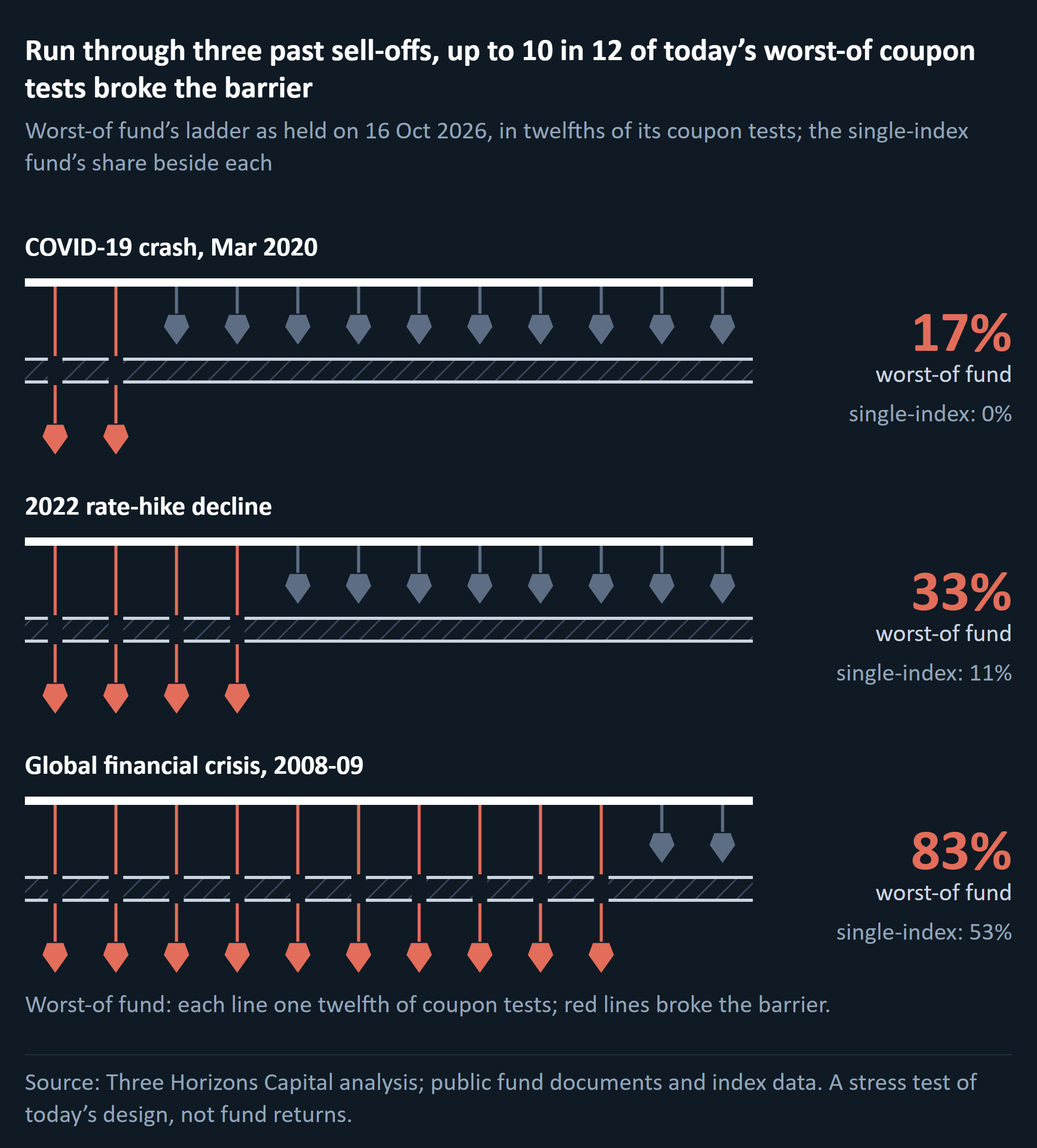
Where the ladder stands when a shock arrives matters as much as its terms
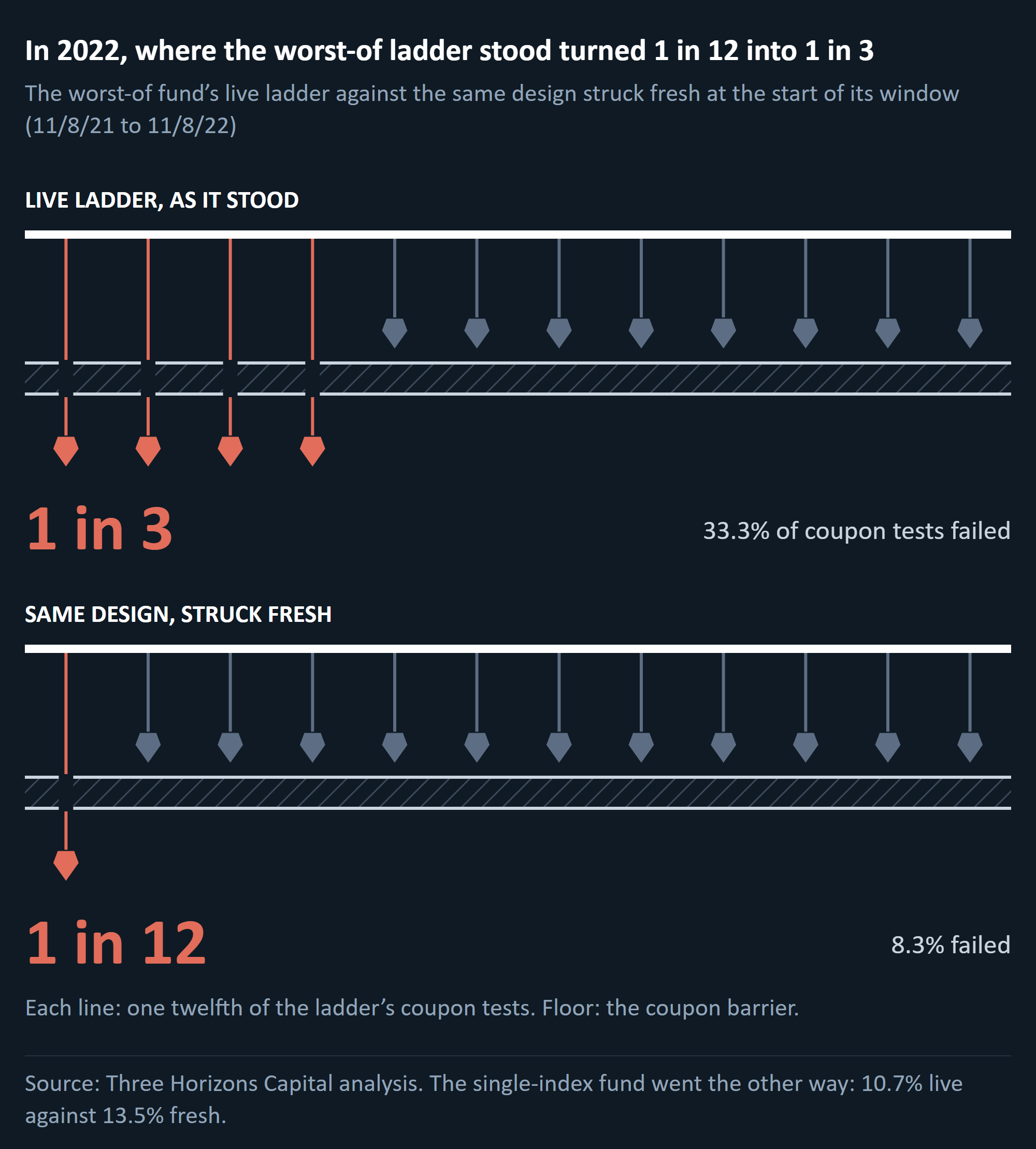
Strikes roll on a calendar, so exposure to the next downturn depends on where live tranches sit when it starts. In the 2022 decline, the worst-of fund's live ladder failed 33.3% of tests against 8.3% for a fresh ladder, 25.0 points worse. The single-index fund's live ladder did 2.8 points better than a fresh one.
Four hypothetical notes point the same way. The two struck at market peaks breached their barriers; the two struck at market lows paid every coupon until called. Those two paid 6.0% and 7.5% a year, against 9.5% and 12.0% for the two that failed: depth and timing buy resilience with income.
What changes for product teams and buyers
- Read the ladder, not only the term sheet. Ask for the distance-to-barrier distribution of the live tranches; it showed the 2022 risk the headline barrier did not.
- Treat worst-of as a reason for a deeper barrier. Hold a worst-of fund to a stricter depth than a single-index fund of similar tenor.
- Design for the drawdowns that have happened. Set depth on history, time strikes to valuation or volatility, and make the memory coupon standard.
Where do your autocallable ladders sit?
Send us the funds you hold or the notes you are designing. We'll map each ladder's distance to its barrier and run it through past sell-offs, and walk you through it on a call in the coming weeks. Get in touch
Read the full report for the four design levers, the four hypothetical notes in full, and what the results do and do not show.
Method in the full report: rolling 12-month coupon-barrier test on each fund's tranches held 16 Oct 2026, applied to past episodes; it measures today's design, not either fund's returns. A failed coupon test is a contractual event, not necessarily realised income loss. Hypothetical notes are unissued and use public index peaks and troughs. Source: Three Horizons Capital analysis; public fund documents and index data. Research, not investment advice.