Portfolio construction
The Return Is Real. So Is the Toll.
Classic cars earn a return that stocks and bonds do not explain. It sits in the best cars, a round trip at auction can cost more than 25% of the price, and the protection thins when markets boil over.
Three Horizons Capital, Research, 15 November 2026. Laurs and Renneboog (2018), 29,002 auction sales; Weisskopf (2026), 13 segment indices over 376 months; listed market data, January 2016 to October 2026. Research, not investment advice.
5.63% a year
What classic cars earned at auction from 1998 to 2017, before costs; blue-chip classics earned 12.50%
-0.06
Correlation of the broad classic-car index with equities, 1994 to 2025, and 0.01 with government bonds
More than 25%
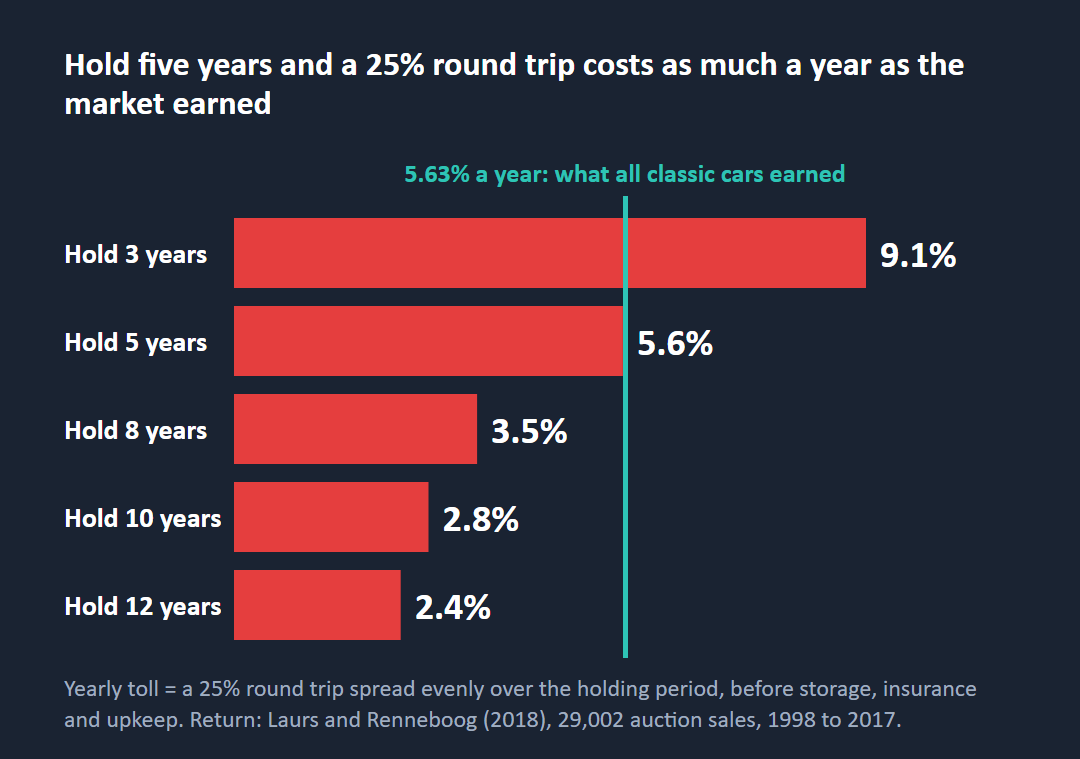
What a round trip at auction can cost; held five years, that is 5.6% a year
The finding in one line
Classic cars earn their place as a small, top-tier position, held for a decade inside a closed vehicle and valued car by car: there the return survives the cost and keeps its distance from markets.
Classic cars earned 5.63% a year before costs, and the best cars more than twice that
Two studies ask whether classic cars behave like a financial asset. Laurs and Renneboog (2018) priced 29,002 auction sales from 1998 to 2017: prices rose 5.63% a year, 3.37% after inflation, before costs. Blue-chip classics earned 12.50% and Italian classics 11.28%. Weisskopf (2026) tested 13 segment indices over 376 months and found the return is its own: the broad index earns 5.2% to 5.6% a year that market factors leave unexplained, and the top-50 index about 8.0%.
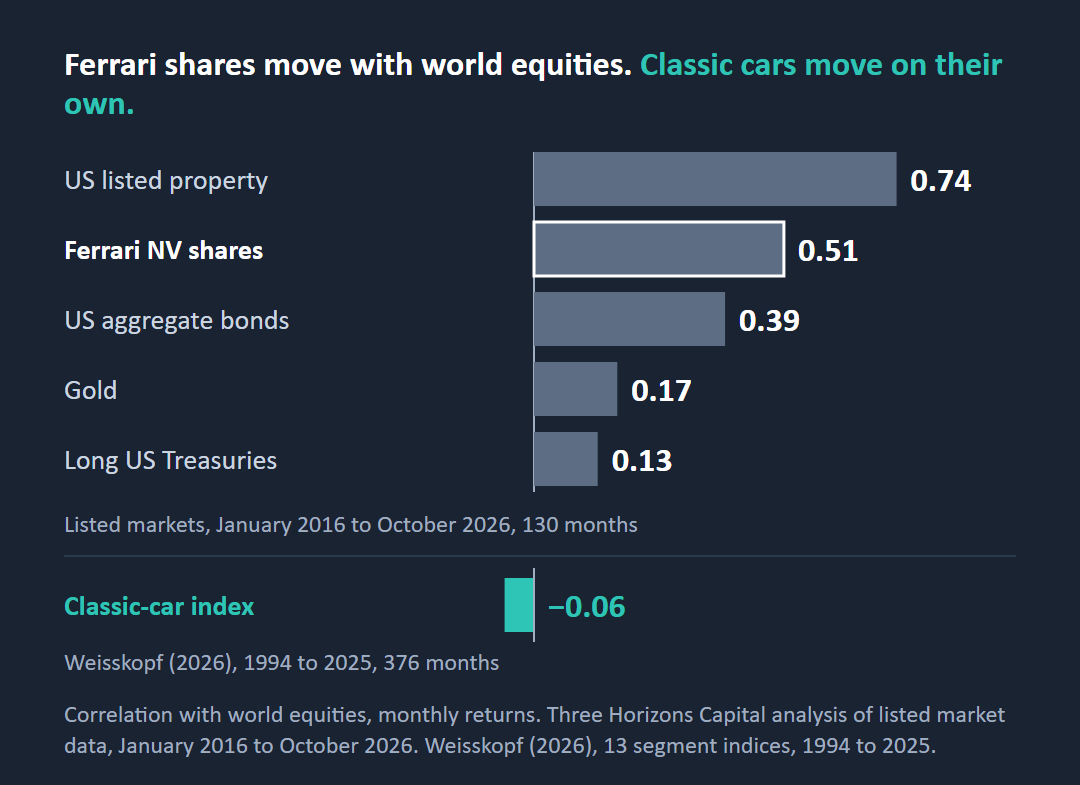
The cars move on their own; the carmaker moves with the market
The broad classic-car index has a correlation of -0.06 with equities and 0.01 with government bonds. In our data, Ferrari shares moved with world equities at a beta of 0.96 over the 130 months from January 2016 to October 2026. Owning the carmaker is an equity position; owning the car is a different exposure. In a boom the shelter thins: in the speculative runs of the mid-2000s and 2013 to 2015, segments moved together, and a Ferrari 250 GTO bought for a little under $14 million in 1989 changed hands for $2.7 million in 1994.
A round trip can cost more than 25%, so the case is top tier, small and long held
Spread over the holding period, a 25% round trip costs 5.6% a year over five years, matching the market's yearly return, and 2.8% over ten. With a 20% buyer's premium charged, the portfolio gain stays material for high-end cars only.
- Hold the top tier only, checked car by car for condition, originality and provenance.
- Keep it small and spread across several marques, as a satellite in the illiquid sleeve.
- Hold for a decade, inside a closed, long-dated vehicle that removes the forced sale.
- Value car by car. Index volatility of about 5.0% a year is a floor, not the risk.
Weighing a classic-car sleeve for clients?
Send us the portfolio. We'll show where a classic-car allocation sits on return, correlation, cost and liquidity next to what you already hold, and walk you through it on a call in the coming weeks. Get in touch
Read the full paper for the segment detail, the boom periods, how to value a car and how we built the figures.
Method in the full paper: Laurs and Renneboog (2018), auction sales 1998 to 2017; Weisskopf (2026), segment indices August 1994 to November 2025, figures quoted as published; listed markets from monthly adjusted prices, January 2016 to October 2026. The yearly toll spreads a 25% round trip evenly over the holding period. Three Horizons Capital analysis. Research, not investment advice.