For CIOs and investment teams at institutional asset managers
The Hours Behind Every Investment Decision
How better-connected investment workflows can create more capacity for judgment, clients and growth.
Tuesday, 9am. The committee agrees:
Cut duration by a year, move 3% from US large cap into EM equity, stay inside the tracking-error limit.
Three Horizons Capital, Research. November 2026. Hours are 3HC estimates, pending practitioner check.
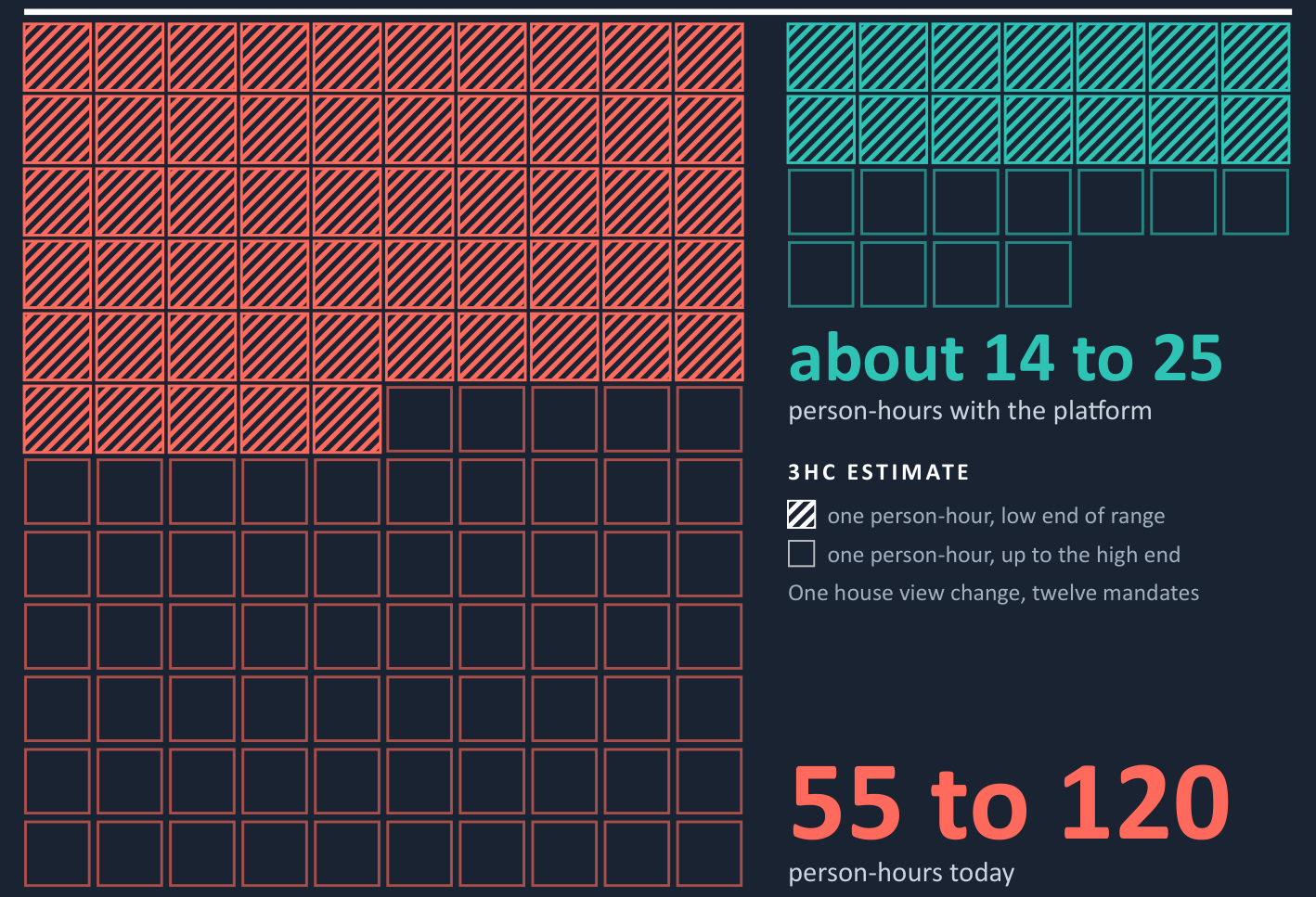
Decided in a sentence. Paid for in hours.
The tax
The hours sit in the handoffs between the decision and the client.
The connection
One continuous thread gives most of them back. People still decide.
The test
What those hours win is something to test. Start with one rebalance.
Decision
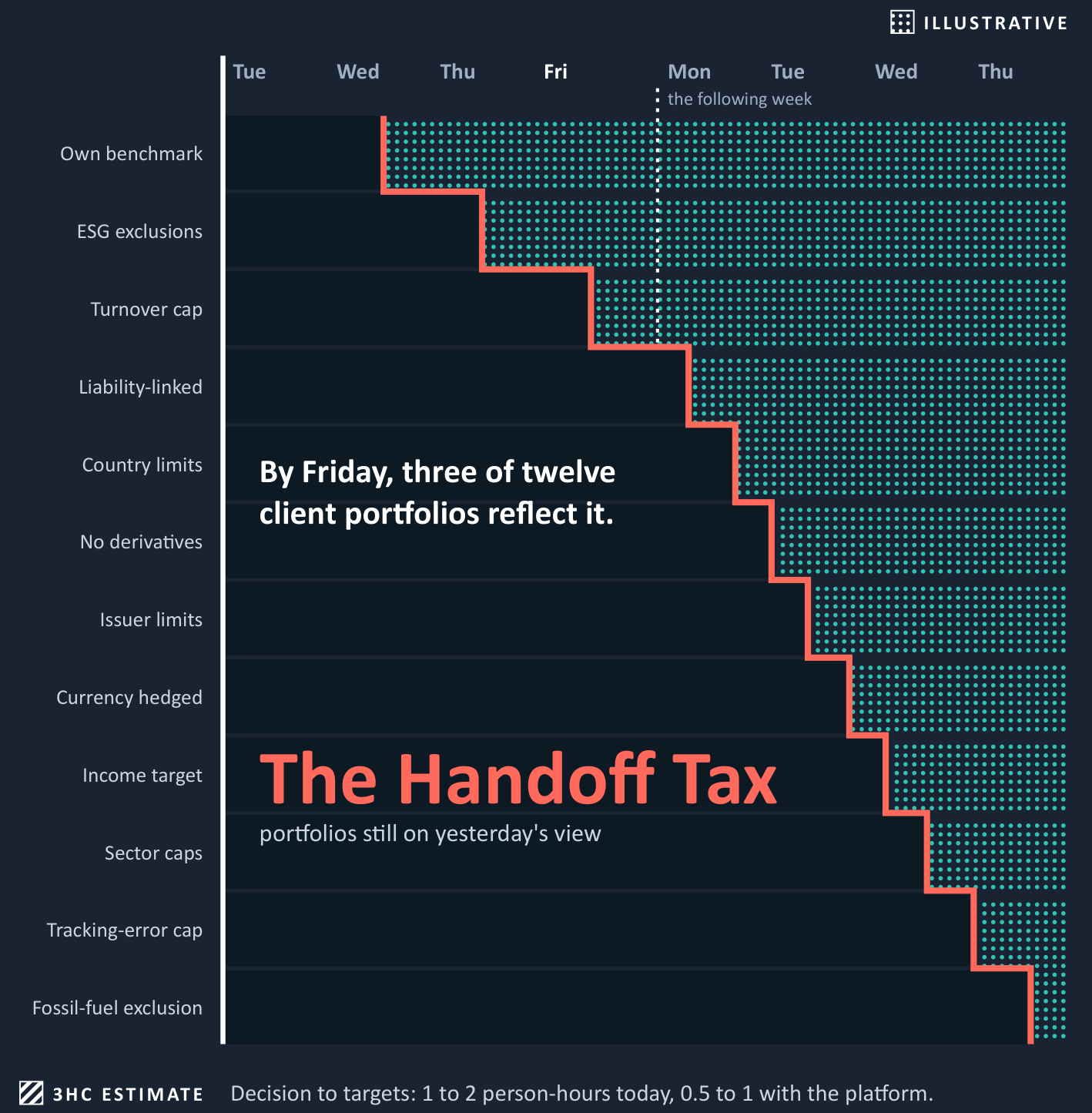
One sentence from the committee becomes twelve different rebalances.
Tuesday, 9am. The committee agrees to cut duration by a year, move 3% from US large cap into EM equity and stay inside the tracking-error limit. One sentence. Then it meets twelve mandates, each with its own limits. Everyone here is careful. The sentence simply has a long way to travel.
Construction
Four people carry the decision, and every handoff charges a tax.
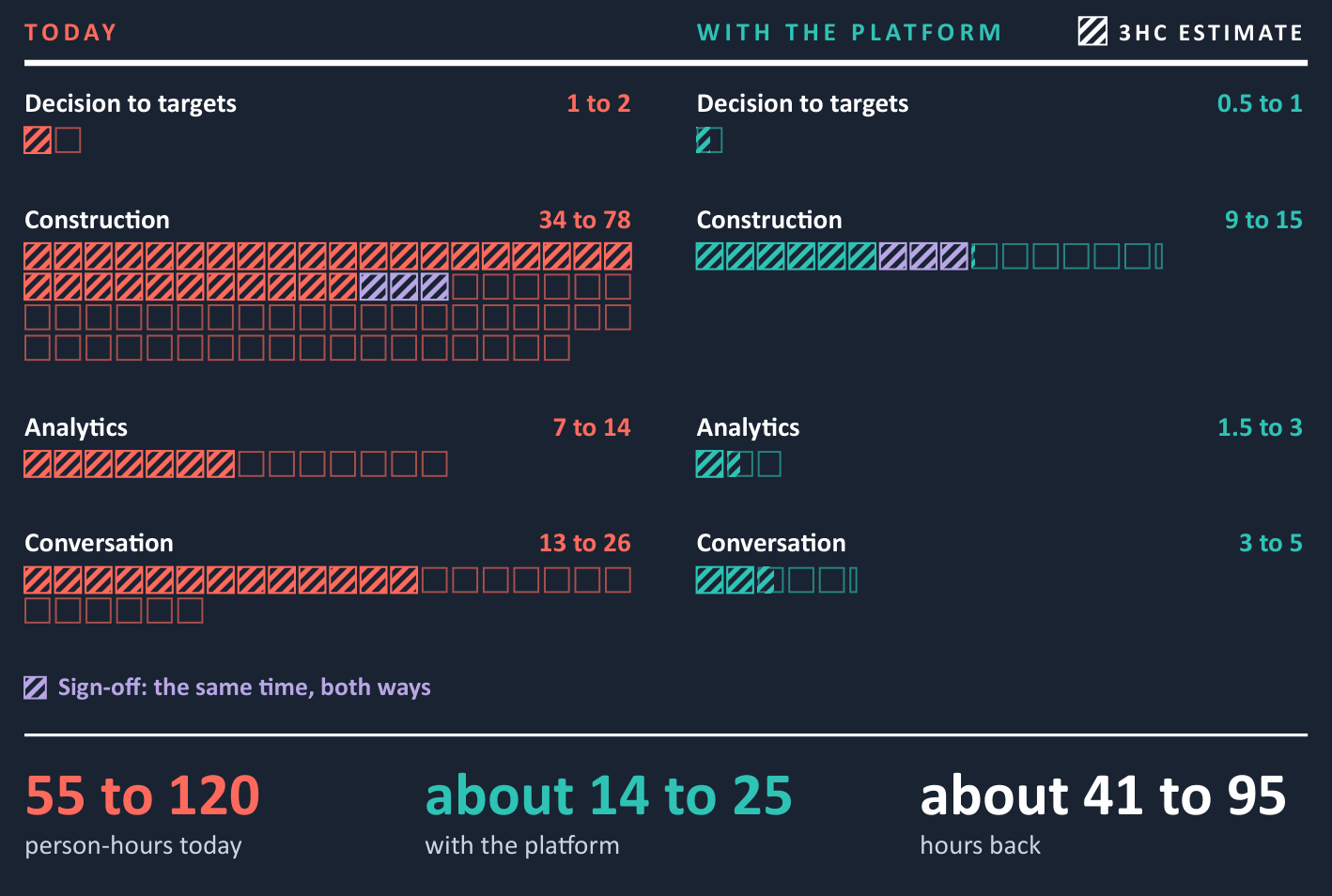
A CIO decides. A researcher supplies the views. A PM sizes positions. A construction analyst builds and checks the trades, and round it goes until it fits. Each pass means a wait, a re-key or a re-run. We call this the Handoff Tax. It falls on skilled people, on the part of the job furthest from judgment.
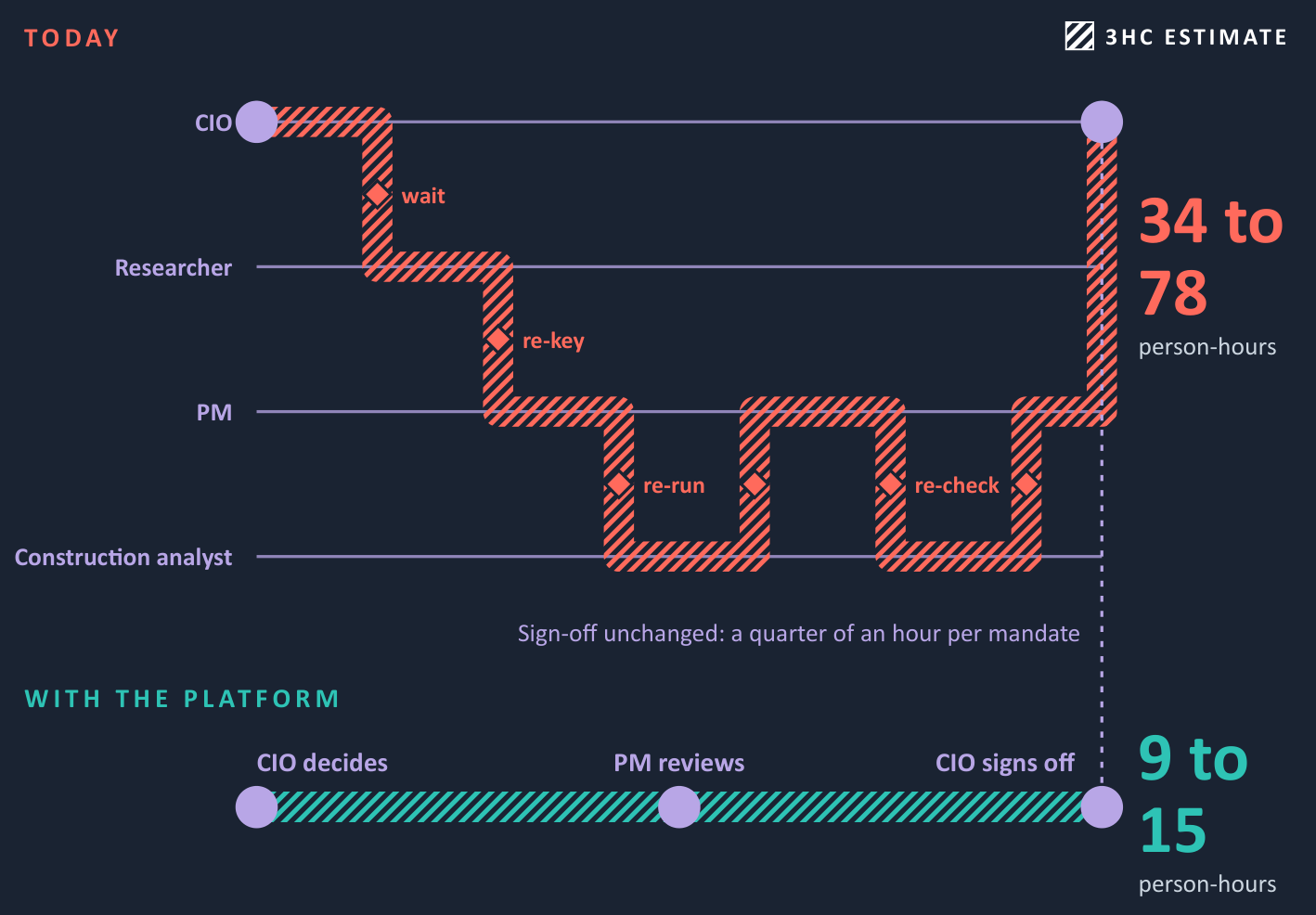
Same four people. Same sign-off. Fewer trips round the loop.
Checks, repeat calculations and trade lists run on one set of data, and analytics starts from there. The PM reviews a draft and the CIO signs off, as they do today.
Some of this tax is worth paying
Your process has been through audits, client reviews and hard markets. Our construction evidence is simulated. With a few similar mandates, the tax is small, and a good analyst with a good spreadsheet is hard to beat. Much of what makes a rebalance right lives in people’s heads: why a limit was set, what a client said last spring. And a second person asking “are you sure?” is a handoff you want to keep.
Analytics
The risk report takes another 7 to 14 person-hours. Whether it arrives in time is a separate clock.
Once the rebalances exist, the question that matters is what they did to each portfolio’s risk. Someone has to explain that, mandate by mandate, then summarise it for the CIO. Analytics reads the same data as the build, so it starts where construction finished.
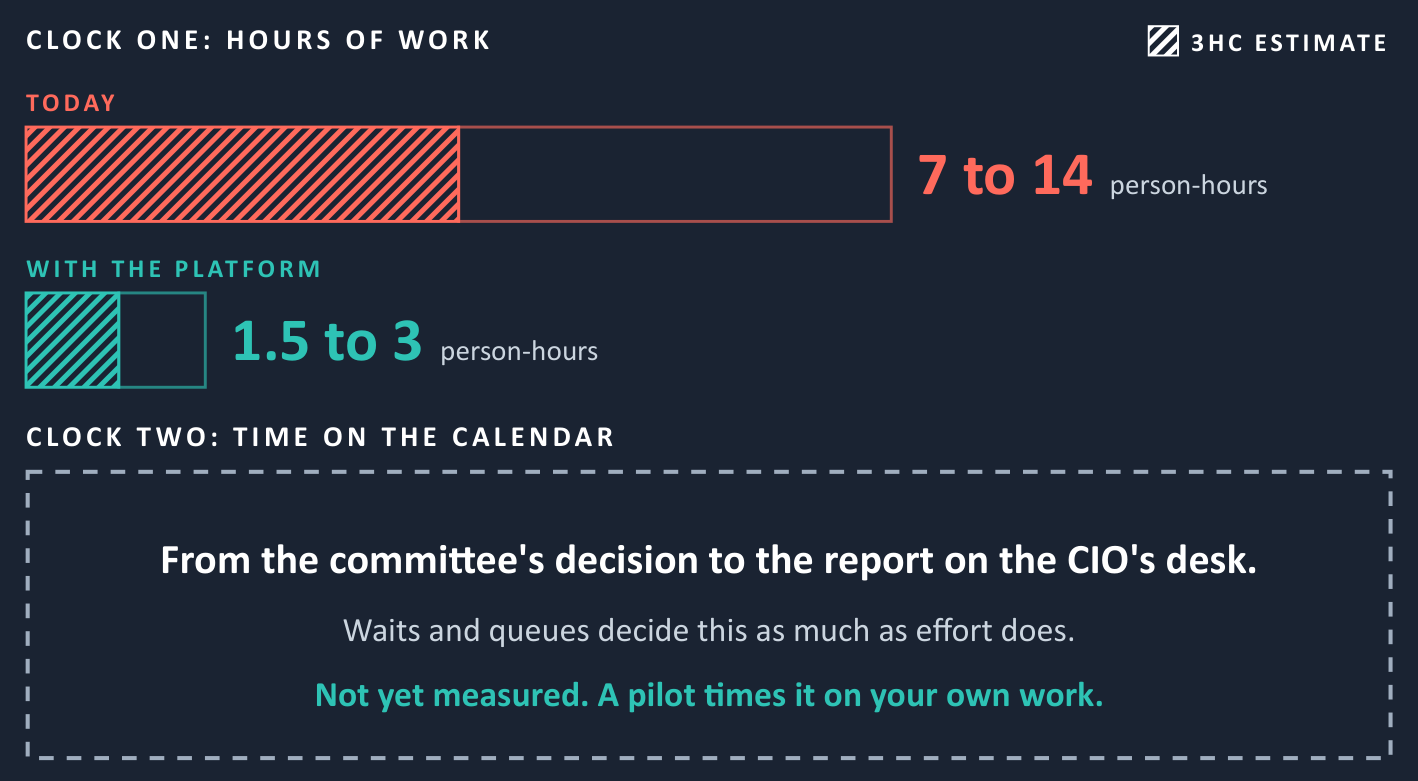
The report has to answer three questions, twelve times.
What changed in this portfolio’s risk?
Is it still inside this client’s limits?
Who needs to know, and by when?
Published research. Institutions feel lateness too: about 55% say private-market reporting timeliness needs improvement.
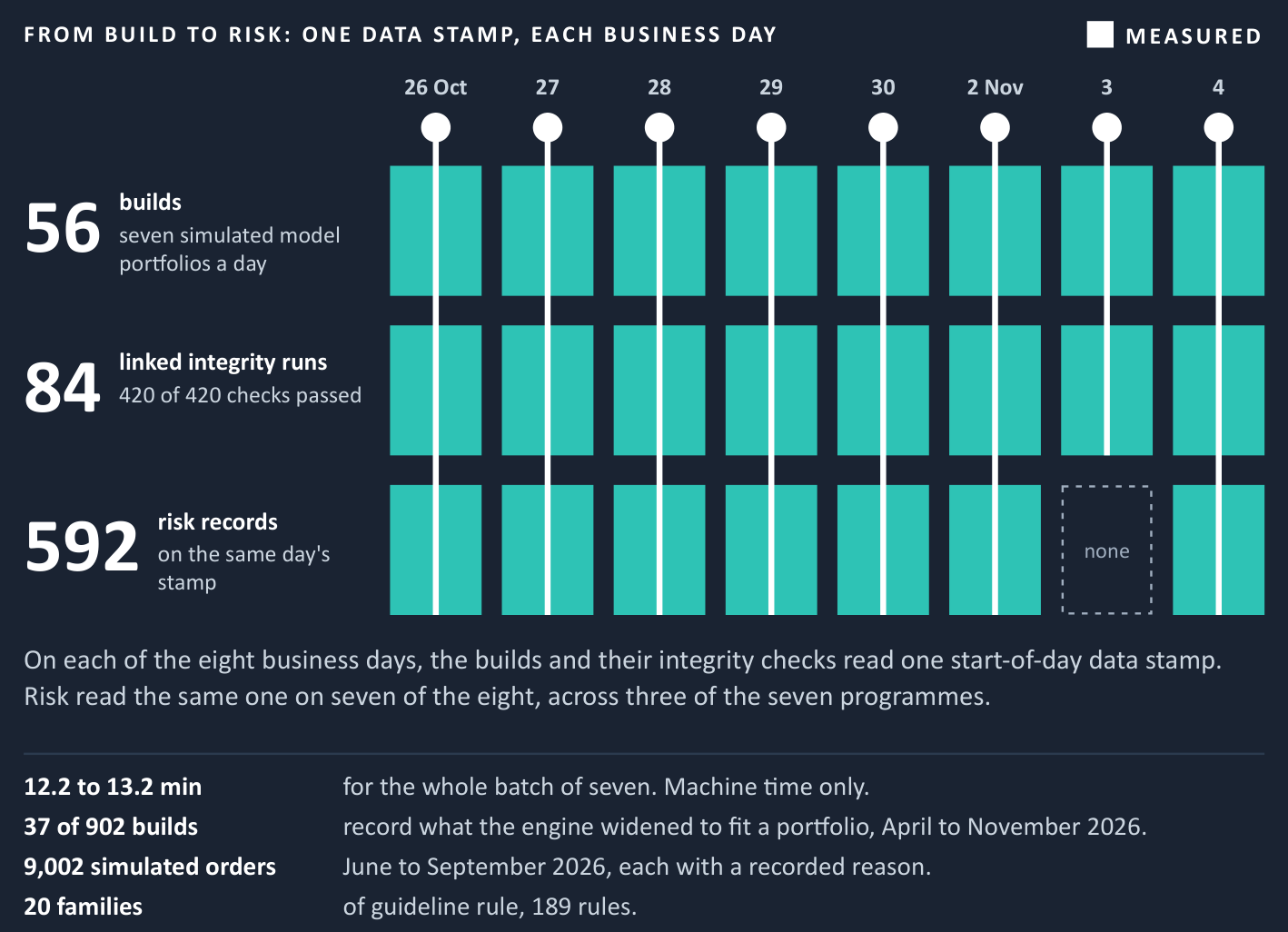
Measured. On the platform’s record, risk read the same start-of-day data stamp as that day’s builds on seven of eight business days (section 06).
Research: Coalition Greenwich, March 2026, global, n=362.
Conversation
Then the decision has to be explained: the meeting before the meeting.
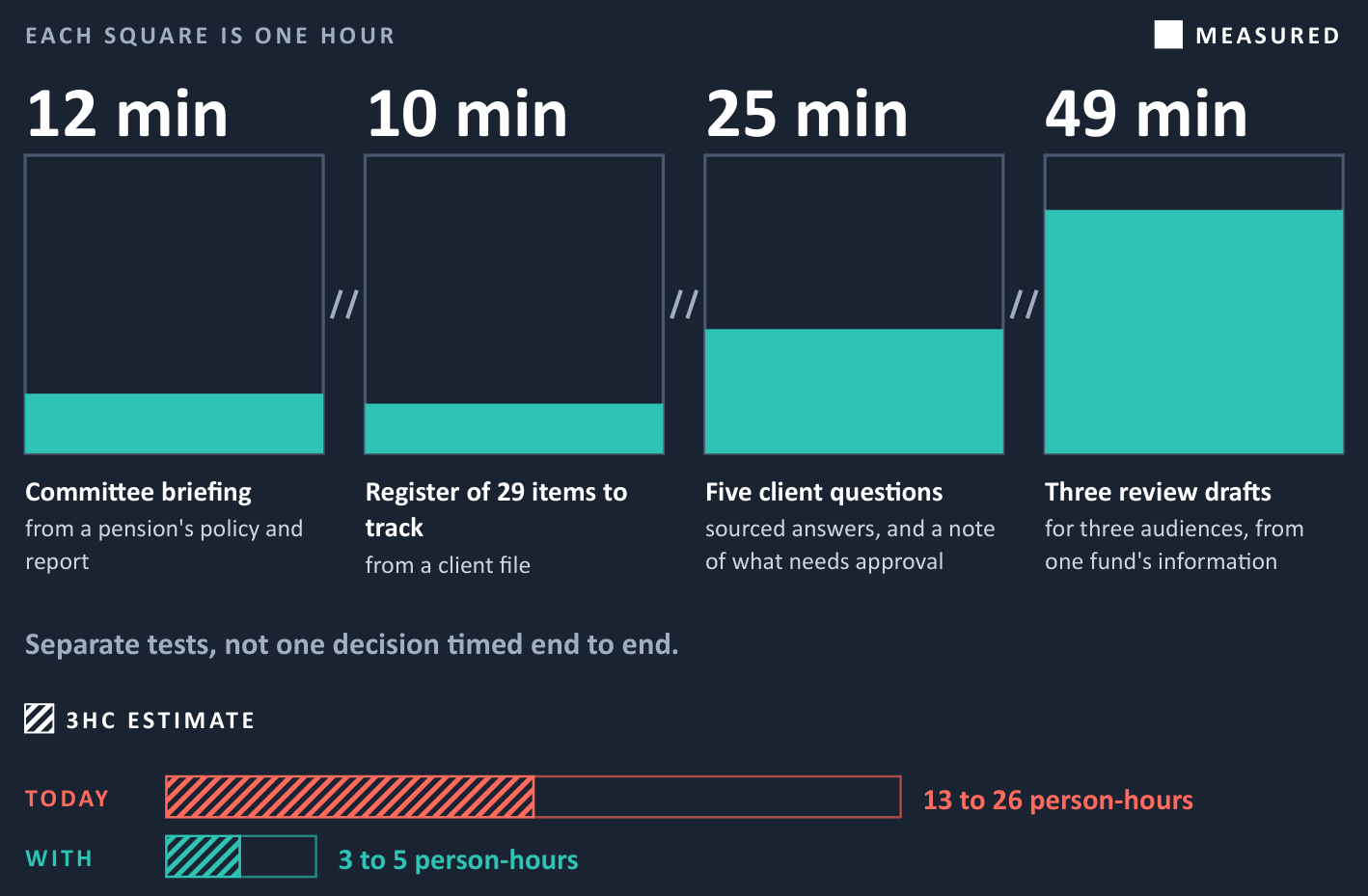
Every decision ends in a conversation. We call the preparation Decision Enablement, and it starts from what construction and analytics already hold. In four separate tests, the platform went from sources to a reviewable draft in minutes, correction included. Timing one decision end to end is what a pilot measures.
Asset manager
Commercial conversations
Wealth manager
Adviser-client conversations
Asset owner
Committee and trustee decisions
Published research. A wealth analogue: “Advisers spend nearly 70% of their time on behind-the-scenes work.”
Deloitte Center for Financial Services (Casey Quirk), May 2026, using Cerulli data; US advisers. Our papers Allocate Your Relationships Like Capital and Distribution Alpha cover the commercial end of this chain.
Added up: 55 to 120 person-hours today, about 14 to 25 connected, with sign-off unchanged.
Sign-off stays a quarter of an hour per mandate, in both lanes, by design. These are hours of work, not days on the calendar. A pilot measures both, and replaces this estimate.
Why this looks bigger than 8%
McKinsey puts gen AI’s efficiency impact at 8% in investment management and 9% in client-facing roles. Our range looks far larger because it measures something far smaller: the support hours in one workflow, one decision across twelve mandates. Narrow the scope and the numbers rise: one top-10 manager “anticipates efficiency gains of roughly 70 percent” on investment-guideline set-up. One firm, one task, an expectation. Ours stays a 3HC estimate until a pilot measures it.
McKinsey, How AI could reshape the economics of the asset management industry, July 2025.
The connection
The intelligence runs through the whole process: each stage starts where the last one finished.
The difference is not three capabilities on one platform. It is how they work together, continuously, throughout the investment process.

Capacity
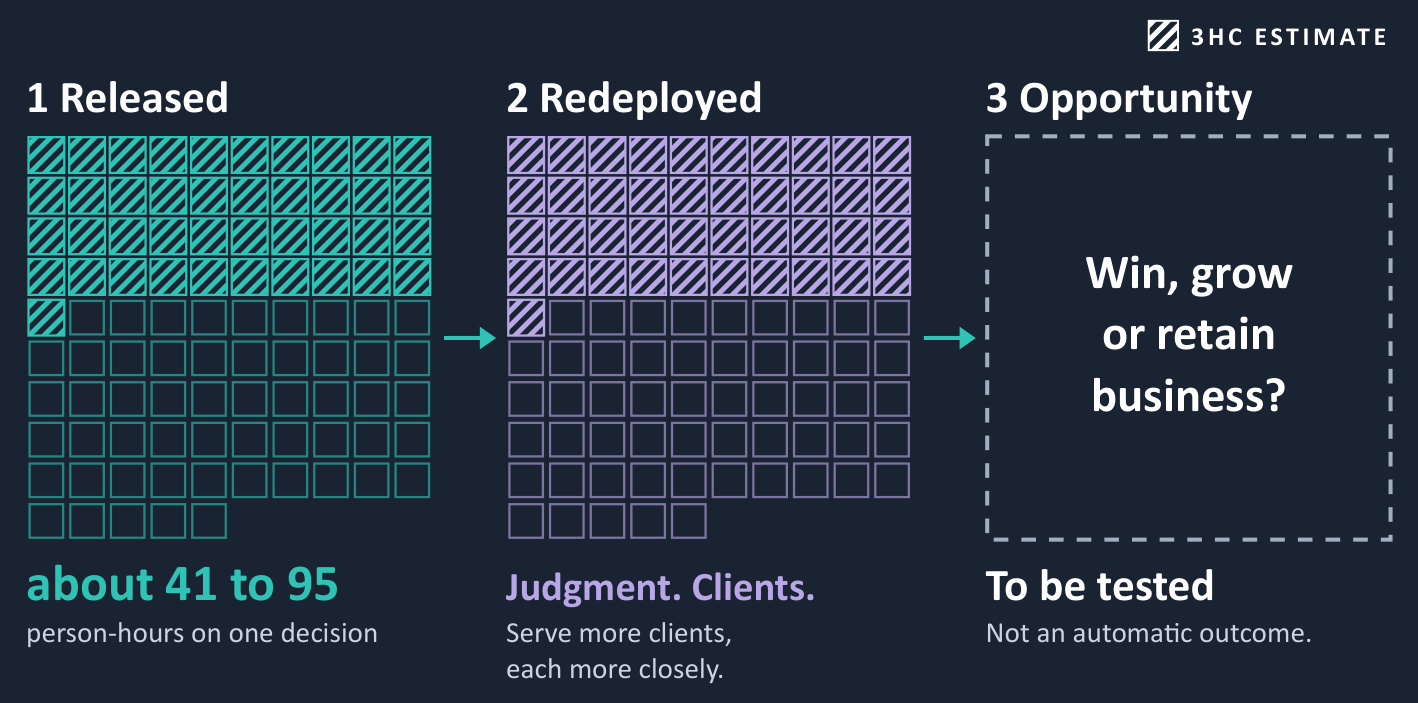
Hours released become growth only if the work is redesigned. That part is something to test.
Everyone in the front office contributes to revenue, including people who never meet a client. Hours alone change little. Factories that swapped steam engines for electric motors gained little until they reorganised the floor around them. McKinsey finds technology spend and productivity correlate at 1.3 percent: “virtually no meaningful relationship”. So redeploy the hours on purpose, then test what follows.
35% to 50%
of client-coverage and distribution capacity could be freed by agentic AI, on BCG’s modelling
Boston Consulting Group, April 2026
62%
of the assets of institutions that use “strategic partner” managers sit with those partners: association, not causation
Coalition Greenwich, May 2025, n=372
Performance
stays “by far the dominant cause” of termination, alongside a “surprising tolerance for underperformance”
Goyal, Tol and Wahal, Financial Analysts Journal, 2023
Released is our estimate. Redeployed is your choice. What it wins, a pilot starts to test.
Coalition Greenwich: 59% of institutions use strategic partners. McKinsey, July 2025. Paul David, The Dynamo and the Computer, American Economic Review, 1990.
Worked examples
Three kinds of client, three decisions, one connected chain.
Three worked examples, from the question on the table to what the client gets. People decide each time. The hours in section 05 cover a house view change only.
Asset managerProduct design
“Launch this strategy with a fossil-fuel exclusion and an income target?”
- DecisionThe proposal goes to the product committee
- ConstructionCandidate versions built under the proposed rules
- AnalyticsEach version’s risk, side by side
- ConversationThe committee decides; sales explains
The outcome to test
A launch, change or stop decision taken with every version’s risk in view, and a sales team that can say why.
Nearest measured test. Three review drafts for three audiences, from one fund’s information: 49 min
Wealth manager or family officeFund due diligence
“Keep, watch or replace this fund on our recommended list?”
- DecisionThe question goes to the investment committee
- ConstructionOne review for each portfolio that holds it
- AnalyticsWhat the fund does to each portfolio’s risk
- ConversationThe committee decides; advisers explain
The outcome to test
One clear decision, and every adviser able to say what it means for each client’s portfolio.
Nearest measured test. Five client questions, with sourced answers and a note of what needs approval: 25 min
Asset ownerScenario analysis and securities research
“Rates and equities fall together. Do we change the policy portfolio?”
- DecisionThe scenario goes to the investment committee
- ConstructionEvery portfolio rerun under the scenario
- AnalyticsScenario risk, then research on the holdings that matter
- ConversationThe committee and trustees decide
The outcome to test
Trustees see the scenario’s effect, and the holdings behind it, before they decide.
Nearest measured test. Committee briefing from a pension’s policy and report: 12 min
Worked examples, illustrative: no client results. Each test was separate and is the closest thing we have timed, not a timing of the example above it. Fund and pension anonymised. Live platform tests, 25 and 26 Oct 2026.
Start with one rebalance: a pilot turns our estimate into your measurement.
Send us one rebalance.
We map it step by step, stage by stage, and a pilot times it on your own work, with sign-off unchanged. The decisions stay yours.
Not another IT project
The 3HC Intelligence Platform works alongside the teams and systems you already have. Your people ask in plain language; approvals route to the portfolio manager or compliance.
McKinsey finds firms “allocate on average 60 to 80 percent of their technology budget to run-the-business initiatives”. This starts with one sentence.
Every step is open: check our estimate, then replace it with your own
One house view change across twelve mandates. Steps marked per mandate are multiplied by twelve. Ranges are 3HC’s first estimate, pending practitioner check; a client pilot replaces them with measurements.
| Stage | Step | Who | Basis | Today | With 3HC |
|---|---|---|---|---|---|
| Decision | Turn the view into target changes | CIO, researcher, PM | once | 1 to 2 | 0.5 to 1 |
| Construction | Assemble holdings, prices, benchmarks, mandate rules | Analyst | once | 1 to 3 | 0.1 to 0.3 |
| Size and check limits, repeated until it fits | PM, analyst | per mandate | 1.5 to 4 | 0.2 to 0.4 | |
| Risk and transaction-cost check | Risk, analyst | per mandate | 0.5 to 1 | 0.1 to 0.2 | |
| Trade list and written rationale | PM, analyst | per mandate | 0.5 to 1 | 0.2 to 0.4 | |
| Sign-off | CIO or PM | per mandate | 0.25 | 0.25 | |
| Analytics | Explain what changed in each portfolio’s risk | Risk, PM | per mandate | 0.5 to 1 | 0.1 to 0.2 |
| Summary for the CIO | Risk | once | 1 to 2 | 0.3 to 0.5 | |
| Conversation | Client, adviser or trustee note for each mandate | Sales, PM | per mandate | 1 to 2 | 0.2 to 0.4 |
| Brief the people who speak to clients | PM, sales | once | 1 to 2 | 0.2 to 0.5 | |
| Total across twelve mandates, person-hours | 55 to 120 | about 14 to 25 | |||
Who we are
Three Horizons Capital is built by investment practitioners. Three of its founders built their careers in Invesco’s systematic and factor investing group as it grew to $40bn; the fourth founded and sold a technology company.
Contact
Andrew Gardner, Chief Operating Officer and Head of Business Development, Three Horizons Capital
andrewgardner@threehorizonscapital.comWe would be glad to walk through what it would take, on a call in the coming weeks.
Less time carrying decisions.
More time making them.
Sources and method
What is measured, and what a pilot measures. Platform record: business days 26 Oct to 4 Nov 2026, seven model portfolios, simulated; 56 builds on 8 daily start-of-day stamps; 84 integrity runs linked to those builds, all on their build’s stamp; 592 risk records on the day’s stamp on 7 days, across three programmes. Machine time only. Live tests: 25 and 26 Oct 2026; answer keys written before each test; 3HC set and scored them. A pilot measures one decision end to end: gathering data, correction, professional review, approval and delivery, in person-hours and elapsed time.
Research. McKinsey, How AI could reshape the economics of the asset management industry, 16 July 2025. Boston Consulting Group, Rebuilding Asset Management for an AI-First World, 28 April 2026. Coalition Greenwich, Institutions Concentrate Assets with Valued Strategic Partners, 6 May 2025 (n=372), and For Institutional Investors, Private Market Tremors Put Spotlight on Asset Manager Communication and Service, 18 March 2026 (n=362). Goyal, Tol and Wahal, Forbearance in Institutional Investment Management, Financial Analysts Journal, 2023. Deloitte Center for Financial Services (Casey Quirk), 20 May 2026. Paul David, The Dynamo and the Computer, American Economic Review, 1990.
Important information
Worked examples and the Tuesday scene are illustrative. Firms, funds and plans are anonymised. Three Horizons Capital is a technology and data architecture company, not a registered investment adviser. For information only. Not investment advice.