Thematic investing
Sports Is a Theme, Not a Factor.
Institutional money is moving into sports. We tracked 18 listed clubs, franchises and competition owners for three years to see whether sports behaves as one asset. It behaves as 18: the return came from which club you owned.
Three Horizons Capital, Portfolio Analytics. Listed prices converted to USD at daily FX, 12 Sep 2023 to 22 Oct 2026; Form ADV private-fund filings; ETF flows to September 2026.
$22.8bn
Held in 99 private funds with “sport” or “sports” in the name, across 46 advisers
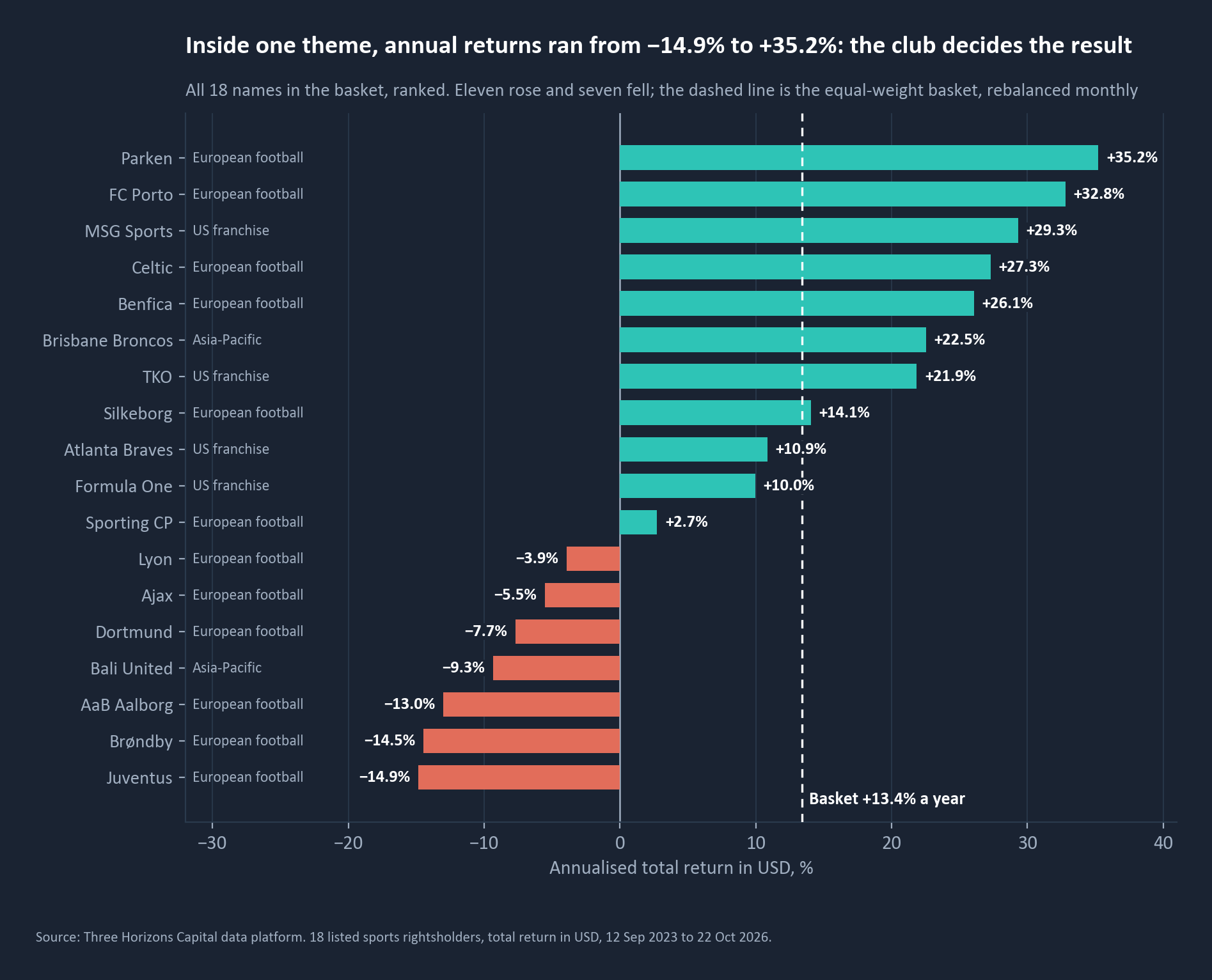
-14.9% to +35.2%
Annual returns of the 18 listed sports names, from Juventus to Parken (FC Copenhagen), in USD
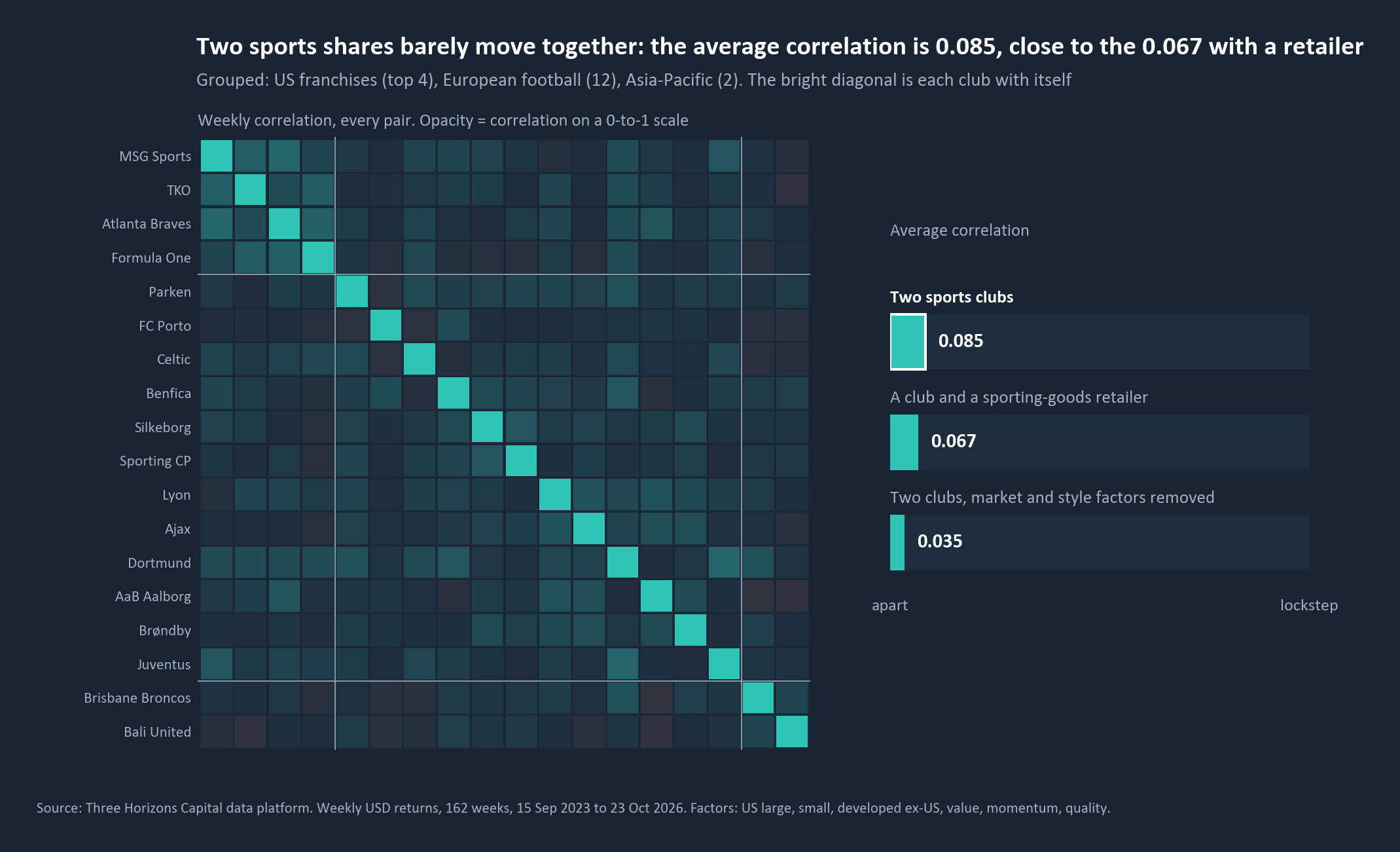
0.085
How closely two sports names move together, on a scale where 1 is lockstep
The finding in one line
Sports is a theme, not a factor: listed clubs and franchises barely move together, so the return comes from which club you own, not from owning sports.
Eighteen sports names, returns 50 points apart
We built a basket of the listed rightsholders (clubs, franchises and competition owners) with a clean three-year daily price history: 12 European football clubs, four US franchises and competition owners, and two Asia-Pacific clubs, one share class per company, measured in USD. From September 2023 to October 2026, Parken (FC Copenhagen) returned 35.2% a year and MSG Sports 29.3%. Juventus returned -14.9% and Brøndby -14.5%. Eleven of the 18 rose and seven fell.
Business model explains part of the gap. The four US franchises and competition owners returned 19.2% a year, the 12 European clubs 10.9%. Yet segment is a starting point, not the answer: inside the US group, MSG Sports returned 29.3% and Formula One 10.0%, and the full 50-point spread sits inside European football alone.
Sports names move with each other about as much as with a retailer
Correlation measures how far two prices move together: 1 means lockstep, 0 means unrelated. Across 162 weeks, the average correlation between two sports names is 0.085. Between a sports name and Dick's Sporting Goods, a retailer, it is 0.067.
We then removed what the wider market explains: the S&P 500, small caps, international stocks, and value, momentum and quality styles. Those six factors account for 11.6% of a typical name's weekly moves. What is left shared between two clubs averages 0.035. The common thread in sports shares is the market, not the sport.
What changes for a manager building around a theme
The basket itself has been a steady holding: 13.4% a year, monthly rebalanced, with a worst fall of -9.3%. Over the same window the S&P 500 returned 20.5% with a worst fall of -16.9%. The basket moved about 0.4% for each 1% in the S&P 500. That calm comes from 18 names pulling in different directions, which is the point.
- Test whether a theme is a factor before you build a product or a sleeve on it. A shared label is a marketing fact; a shared return driver is an investment one.
- Select, don't buy the label. In sports the return sits in the club, the league and the business model.
- Measure what you own. Correlation, market sensitivity and trading depth, name by name, before the theme reaches a client.
Read the full report for all 18 names, the segment split, the private-fund and ETF evidence, and what the results do and do not show.
Method in the full report: equal-weight basket of 18 listed rightsholders, prices converted to USD at daily FX; correlations and factors on weekly returns. Research, not investment advice.