Portfolio construction
Same Values. New Wrapper.
Faith-based investors are keeping their screens and changing how they hold them. Across 209 faith-screened funds in four traditions, ETFs hold 15% of the assets but took in $5.3bn of net new money in a year, while mutual funds saw net outflows. The shift shows up in every faith in our data.
Three Horizons Capital, Portfolio Construction. Fund-level data: 209 faith-screened funds, $130.5bn, in 9 fund domiciles. Net flows over the 12 months to 30 September 2026; fund sizes at 9 November 2026. Research, not investment advice.
15% and +$5.3bn
ETFs' share of faith-screened fund assets, and their net inflows over the 12 months to 30 September 2026
47 of 50
Faith-screened ETFs that took in money over the year, against 81 of 157 mutual funds
+$3.6bn
Net inflows into Islamic ETFs, the largest block of new money, almost all of it in Irish and US funds
The finding in one line
Faith-based demand is growing, and it is arriving in ETFs: the screen still decides what investors buy, and the wrapper now decides where they buy it.
Faith-screened funds hold $130.5bn in our data, and took in +$4.5bn of new money in a year
We mapped every fund in our data whose mandate applies a religious screen: 209 funds holding $130.5bn across four traditions and 9 fund domiciles. Christian (Protestant and Evangelical) funds are the largest group at $60.5bn, followed by Islamic at $44.1bn, Catholic at $25.6bn and one Jewish fund at $0.3bn.
Together they took in +$4.5bn over the 12 months to 30 September 2026, up from +$3.4bn the year before. Islamic funds led with +$5.0bn, 11.3% of their assets.
The new money went to ETFs: 15% of the assets, +$5.3bn of the flows
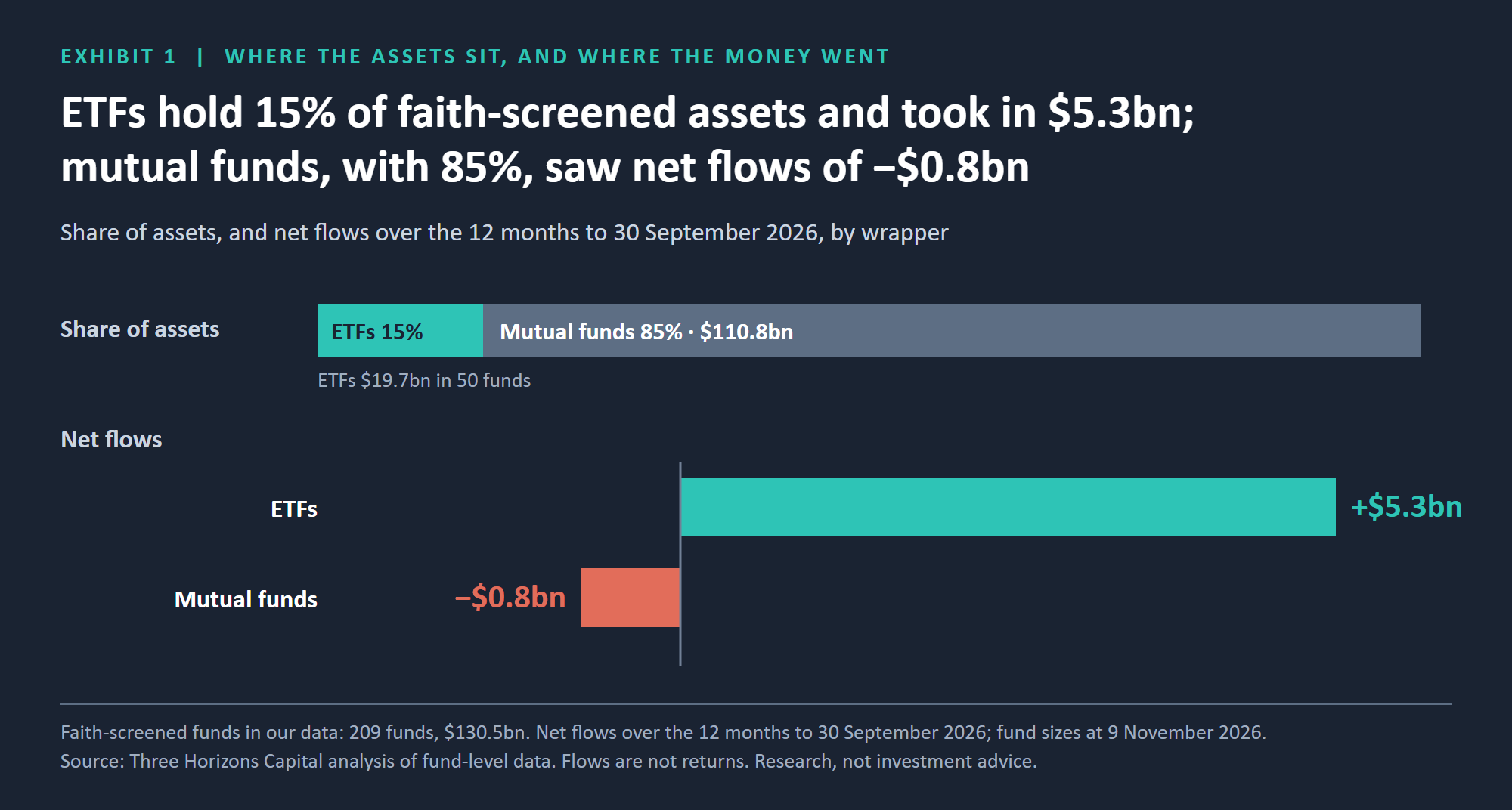
ETFs hold $19.7bn, 15% of faith-screened assets, and took in +$5.3bn, up from +$2.9bn the year before. Mutual funds hold the other 85% and saw -$0.8bn. The breadth is as striking as the total: 47 of 50 faith-screened ETFs took in money, against 81 of 157 mutual funds.
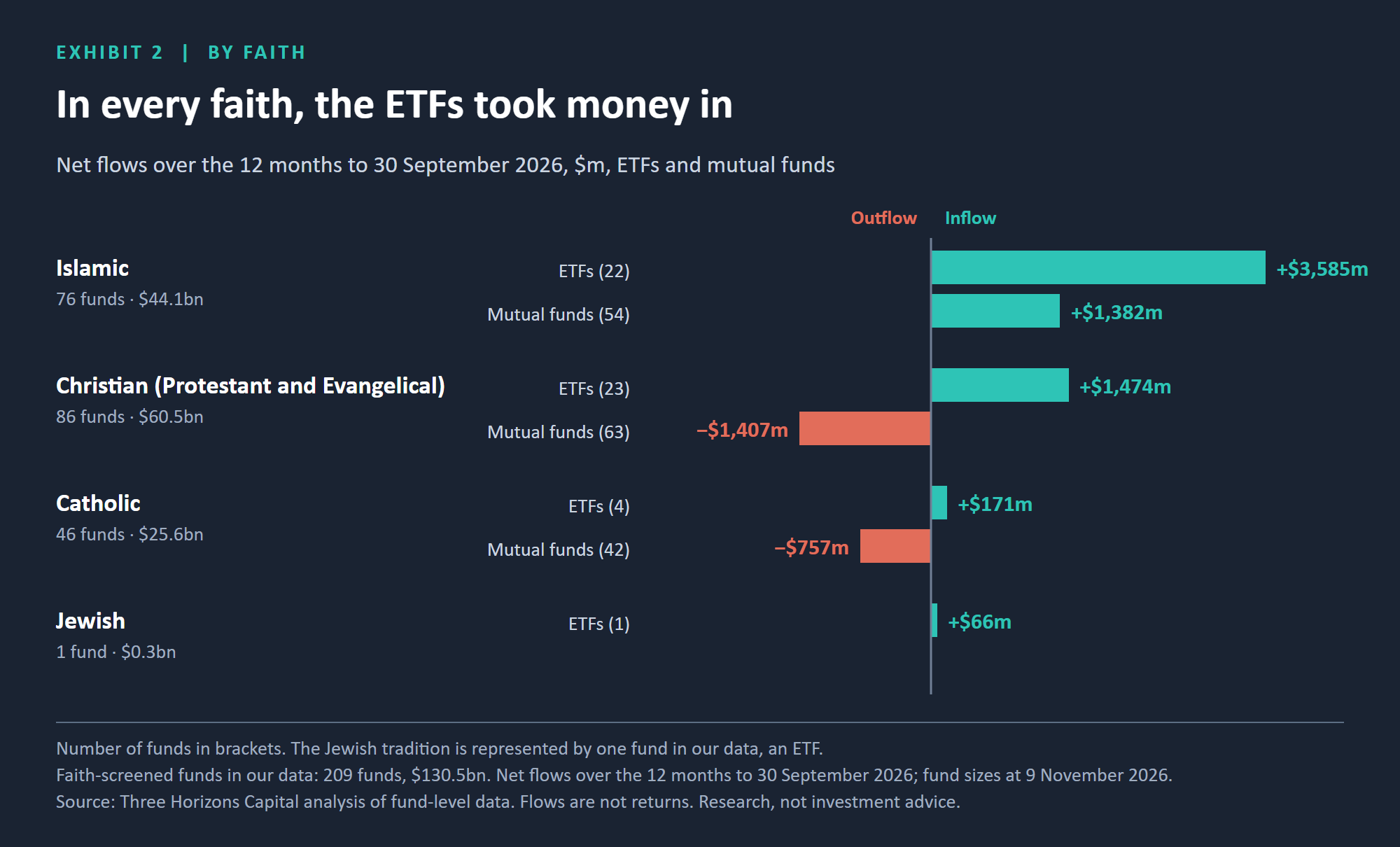
The pattern holds in every tradition. Islamic ETFs took in +$3.6bn, almost all of it in Irish-domiciled UCITS ETFs (+$1.7bn) and US ETFs (+$1.8bn). Christian ETFs took in +$1.5bn while Christian mutual funds saw -$1.4bn, so the Christian shelf was steady overall and the money changed wrapper. Catholic ETFs took in +$171m while Catholic mutual funds saw -$757m.
The screen is the product; the wrapper is how it reaches the investor
For managers, three things follow.
- Keep the screen, offer the wrapper. Investors are not leaving their faith screens. They are choosing the same screens in an ETF.
- Islamic demand sits in two markets. Islamic ETFs gathered in both Ireland and the US, so a UCITS listing and a US listing reach different buyers of the same screen.
- The mutual fund base is still 85% of the assets. Some of the largest mutual fund inflows went to index funds, so cost and simplicity matter as much as the wrapper.
If this is useful
If you run or distribute a faith-screened range, we can show where the demand for your screen sits, by wrapper and by market, and walk through it on a call in the coming weeks. Get in touch
Method in the full paper: fund-level net flows, one value per fund per month, over the 12 months to 30 September 2026 and the 12 months before; fund sizes at 9 November 2026 in US dollars. A fund is counted when its mandate applies a religious screen, confirmed against the sponsor's own description. One large faith-affiliated sponsor whose faith-based portfolios are built from other managers' funds is shown separately and is not in these totals. Flows are not returns. Source: Three Horizons Capital analysis. Research, not investment advice.
More research
- Read the full paper: the screens behind each tradition, the domiciles, and the fund-level tables.
- Five ETFs. Five Different Jobs.: where ETF demand is moving in the US, Europe and the UK.