Portfolio construction
Protected Against the Wrong Shock.
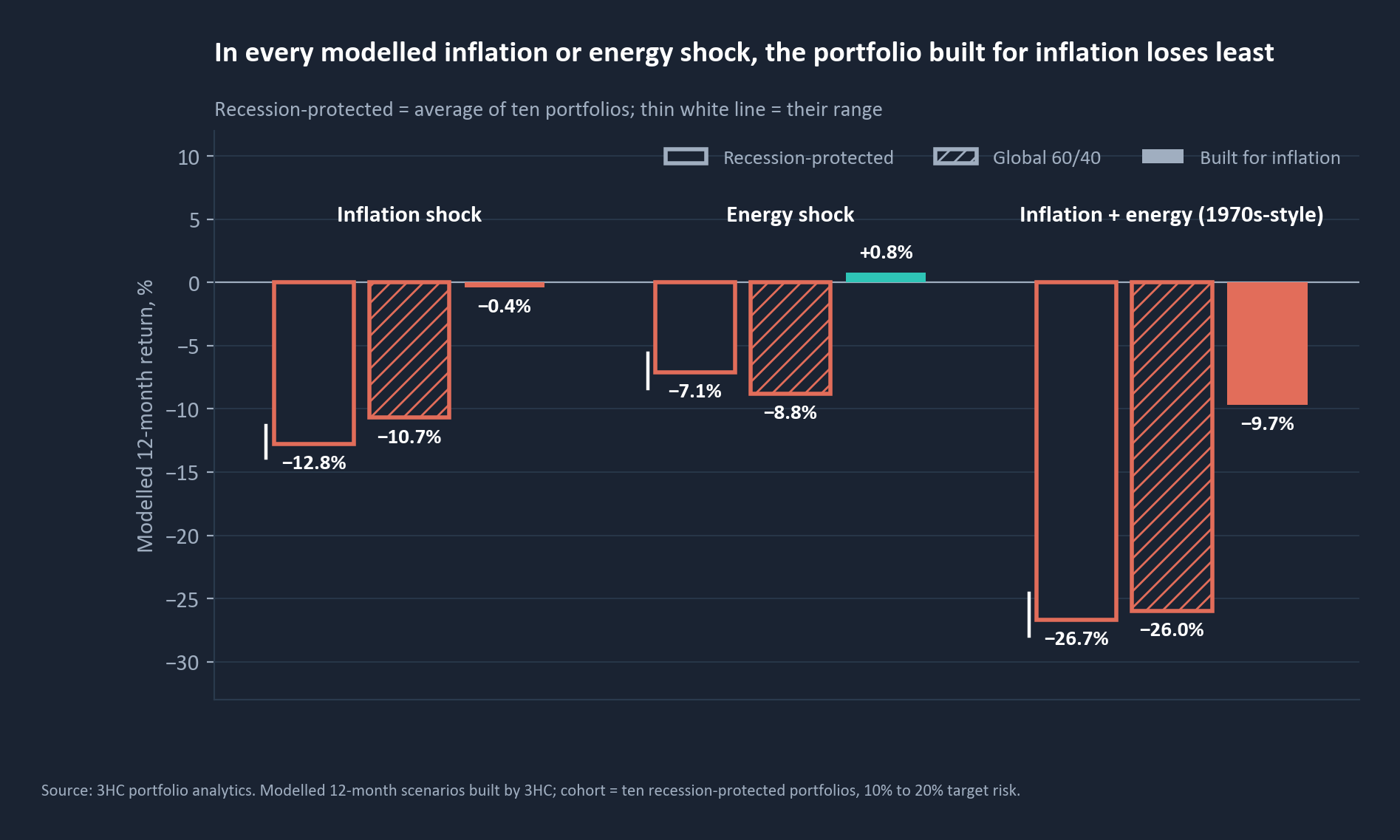
Most portfolios built to survive the next crisis are built to survive a recession: long duration, quality equity, defensive credit. We stress-tested ten of them against three inflation and energy shocks we built for this study. In a 1970s-style shock all ten lose a quarter of their value. A portfolio built for the other regime loses 9.7%, and in 2022 it lost 8.3% against 14.9%.
Three Horizons Capital, Portfolio Analytics. Modelled 12-month scenarios built by 3HC; realised monthly-rebalanced returns, August 2013 to September 2026.
-26.7% vs -9.7%
Average modelled loss of ten recession-protected portfolios in a combined inflation and energy shock, against a portfolio built for inflation
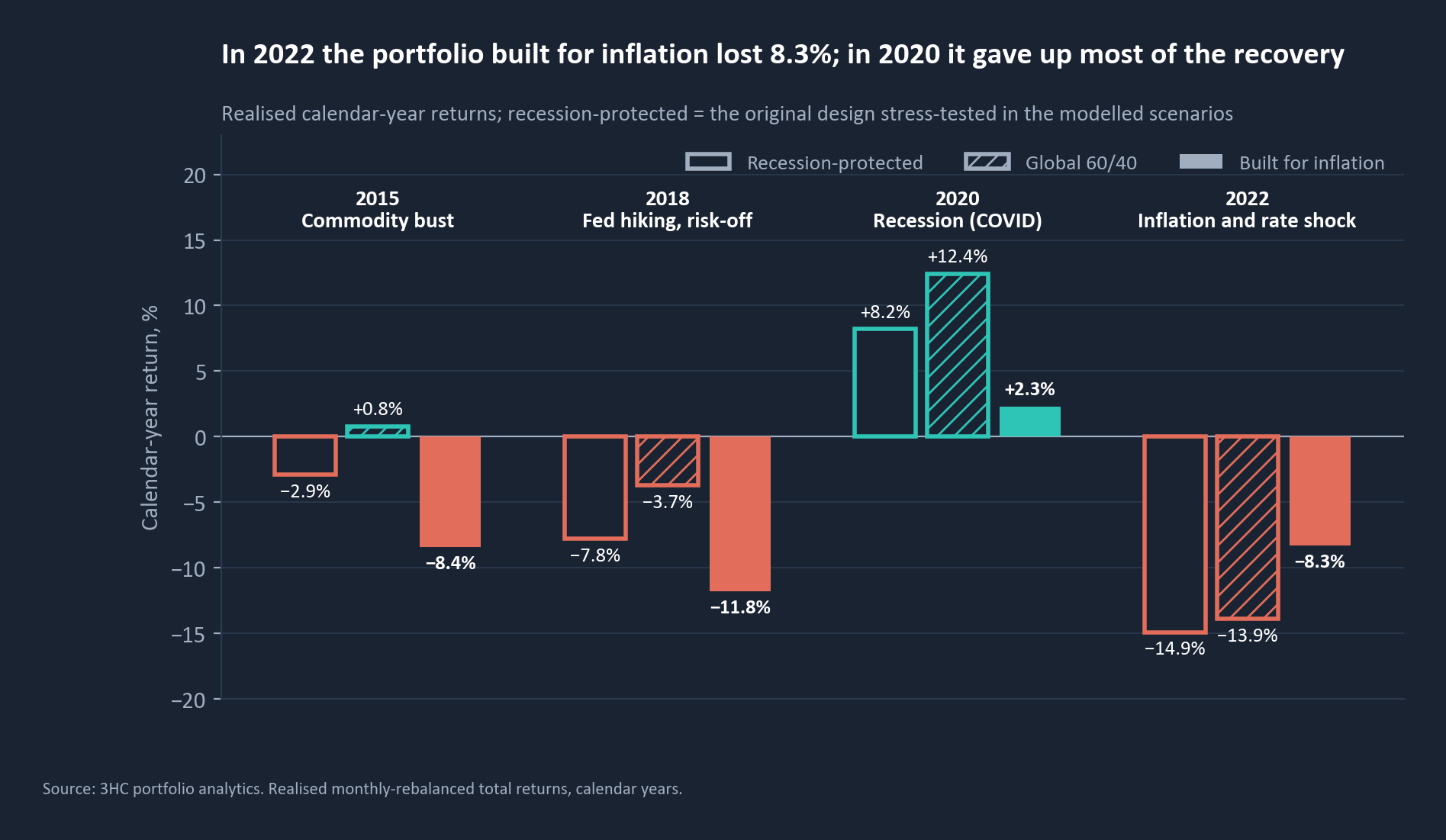
-14.9% vs -8.3%
What actually happened in 2022: the recession-protected design against the portfolio built for inflation
+8.2% vs +2.3%
The price, in 2020's recession: the portfolio built for inflation gave up most of the recovery
The finding in one line
Recession protection and inflation protection are different problems: the assets that shield a portfolio in a downturn are the ones that hurt it when inflation and rates surge, so a portfolio protected against one shock is exposed to the other.
The recession hedge breaks in an inflation shock
We built three 12-month shocks calibrated to history: an inflation shock (like 1983 and 2021 to 23), an energy shock (like 1973 to 74 and 2022) and a combined, 1970s-style shock with oil +100% and headline CPI +550bp. In our inflation shock, long Treasuries fall 47.6% and investment-grade corporates 21.3%: the very assets that protect a portfolio in a recession. Ten recession-protected portfolios, from 10% to 20% target risk, lose 24.6% to 28.0% in the combined shock. A portfolio built for inflation loses 9.7%, and a global 60/40 26.0%.
In 2022 it actually happened, and the protection has a price
On realised returns from August 2013 to September 2026, the portfolio built for inflation lost 8.3% in 2022, against 14.9% for the recession-protected design and 13.9% for a global 60/40. The protection is not free: in 2020's recession it made 2.3% while the recession-protected design made 8.2%, and over the full window the 60/40 had the better Sharpe ratio.
What changes for a portfolio
Each design wins its own regime and pays in the other. That makes them complementary sleeves, not rival portfolios.
- Test the book against both regimes, not only a recession.
- Know which assets change sides: long duration and investment-grade credit shield a downturn and lead the losses in an inflation shock.
- Judge protection in the tail months, where the designs behave completely differently.
Read the full report for the three scenarios, all ten portfolios, the portfolio built for inflation, the full backtest and what the results do and do not show.
Method in the full report: scenarios constructed by 3HC and applied across 58 asset classes; realised monthly-rebalanced returns. Research, not investment advice.